
The Other America shook the country in 1962. With a carefully researched non-fiction book, Michael Harrington laid open the wounds of poverty in the United States as dramatically as muckrakers like Upton Sinclair had in novels published half a century earlier. The paperback edition of The Other America sold over a million copies and is often credited with inspiring and making possible the War on Poverty that brought us Medicare, Medicaid, the food stamp program, Head Start, and dozens of lesser-known programs.
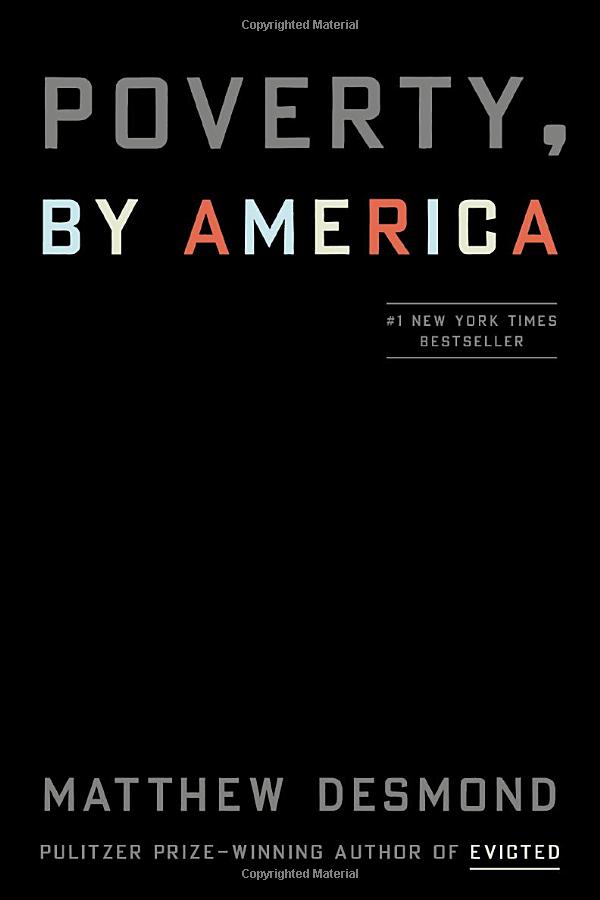
In Poverty, by America, Matthew Desmond exposes the systematic nature of poverty and racism and their historic and contemporary interconnection in the United States. His careful research backs up his insistence that we can and must abolish poverty, that the cost of doing so is well within the realm of the possible.
Desmond, a sociologist, won a Pulitzer Prize for his earlier book, Evicted, in which the stories of eight struggling families in Milwaukee illuminate the inequities of unaffordable housing and reveal who profits from the misery of eviction. While Poverty, by America focuses more on systems than on individual stories, the passion and compassion Desmond brought to Evicted continue in this volume.
Desmond eloquently analyzes the “tight knot of social maladies” that are “connected to every social problem we care about—crime, health, education, housing,” meaning that “millions of families are denied safety and security and dignity in one of the richest nations in the history of the world.”
Poverty remains profitable. Exploitation of workers is real, and so is union-busting. Tax laws subsidize homeownership. Zoning laws and housing segregation reinforce concentration of wealth and restriction of opportunity. Tax cuts benefit the very wealthy and are paid for by cuts to public programs that benefit the poor. Reagan signed a 1981 tax cut that reduced federal tax revenues by 13 percent over four years. The tax cut included a 20 percent cut in the top marginal tax rate, which has been reduced by another 13 percent since then. At the same time, the budget for the Department of Housing and Urban Development was slashed by 70 percent. The direct relationship between lower taxes for the very wealthy and destruction of programs to help the very poor could not be clearer.
There’s more—so much more. For example, Desmond pulls back the curtain that conceals the diversion of anti-poverty funding to non-poor people and programs. You might remember the $1.1 million taken from federal anti-poverty funds and paid former NFL quarterback Brett Favre in Mississippi for inspirational speeches. While Favre never gave the speeches and was eventually shamed into giving back the money, Mississippi also spent federal anti-poverty funds on college football tickets, a free fitness camp for state legislators, and other boondoggles. Arizona used anti-poverty funds to pay for abstinence-only sex education; Main paid for a Christian summer camp … the list goes on.
Read the book! Don’t be deterred by its 402-page length: almost half of those pages are footnotes at the back, documenting Desmond’s careful research.
As a nation, we have the means to abolish poverty. Desmond calls for each of us to join in a mass movement to abolish poverty. “Movements need people to march, but they also need graphic designers and cooks and marketing professionals and teachers and faith leaders and lawyers,” he reminds us.
“The end of poverty is something to stand for, to march for, to sacrifice for. Because poverty is the dream killer, the capability destroyer, the great waster of human potential. … The citizens of the richest nation in the world can and should put an end to it.”
Discover more from News Day
Subscribe to get the latest posts sent to your email.

 Mary Turck