
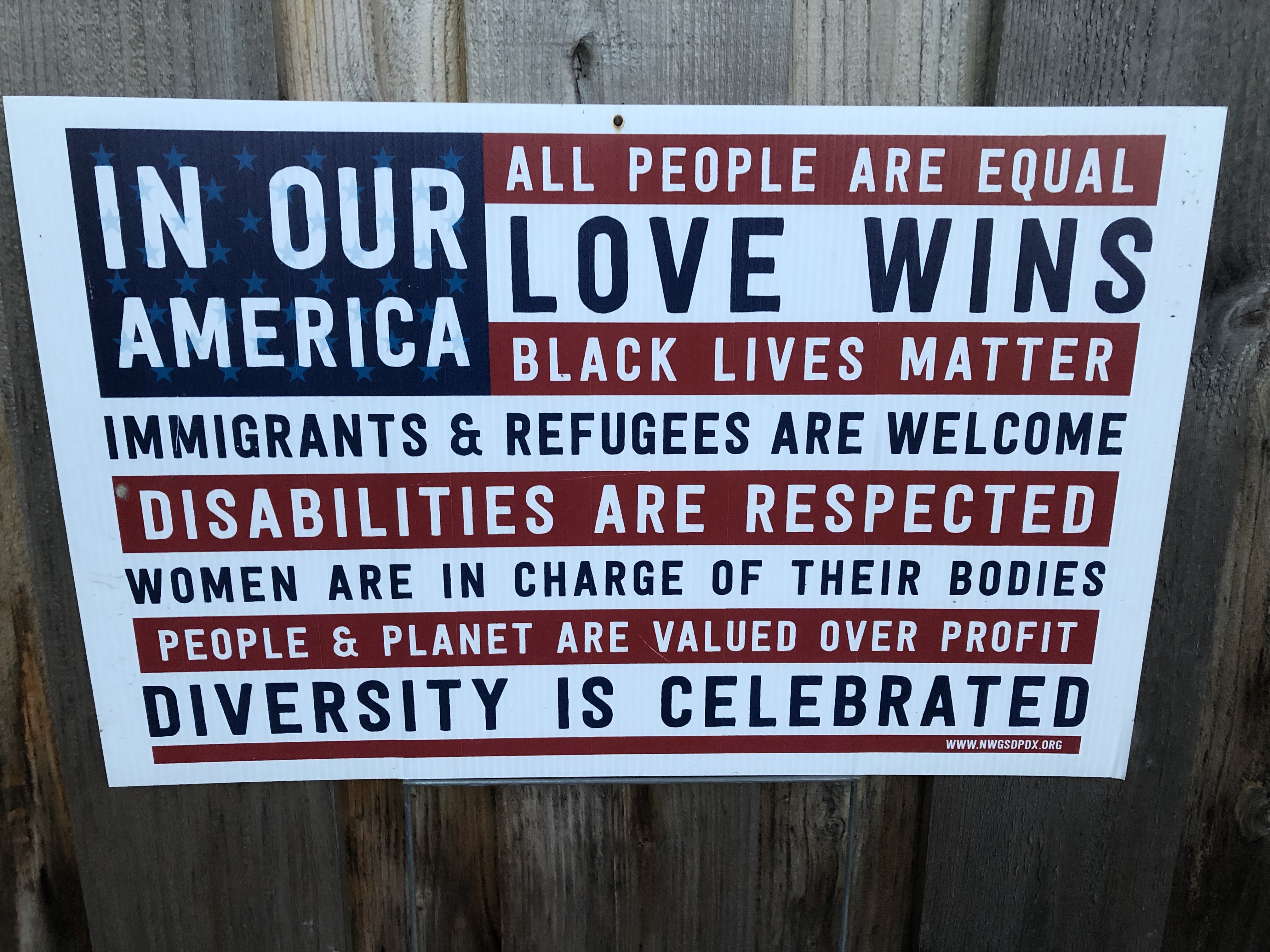
Three years ago, Trump and his mob tried to destroy democracy and the rule of law. They failed. They are still trying. We still need to keep resisting.
That means resisting the lies of the deluded right-wing minority. Trump has never had the support of a majority of the country. Even when he became president, he had only minority support. He lost the popular vote in 2016, with Hillary Clinton getting almost 2.9 million more voters than Trump had. Yes—he won in the electoral college and became president with a minority of votes cast in the election. In 2020, Trump lost to President Joe Biden by an even larger margin: more than 7 million votes. This time he also lost in the electoral college, by a vote of 306 to 232.
A large majority of people in this country support the rule of law, equal treatment for all races, religions and ethnicities, a woman’s right to choose, asylum for people fleeing persecution, welcome for Dreamers, protection for trans children, equal rights for LGBT people … the list goes on. The loud minority threatens because they are loud, because they lie, and because they (some of them, at least) even come to believe their own lies.
Their loud and repeated lies endanger the rest of us, too. They flood social media with lies and slime, promoting a cynicism that says all politicians are crooks and liars, facts are unknowable, and all opinions are equal. That cynicism leads to a rejection of civic involvement and political participation at the very time we need it most.
Facts matter. Timothy Snyder said it succinctly in his essay On Tyranny, which I highly recommend:
“Believe in truth. To abandon facts is to abandon freedom. If nothing is true, then no one can criticize power, because there is no basis upon which to do so. If nothing is true, then all is spectacle. The biggest wallet pays for the most blinding lights.”
When I think about how to resist, how to fight, how to keep on, I think back to the civil rights movement, which inspired my political and spiritual life. Lessons from the civil rights movement, and later from Central American liberation movements, still keep me going and give me hope. Among those lessons:
1) Community gives strength. My dad taught through an old example: Take a stick and break it. Easy. Now put ten sticks together in a bundle. Can you break them? Not a chance.
That’s why we march together, sing together, go to meetings and join organizations. Together, we can argue issues and strategies. Together, we can make banners and march down streets. Together, we can hold one another up and lend strength when hope gives out. Together, we might even grow lasting friendships.
2) Power comes from love. Dr. Martin Luther King, Jr.’s quote says it all:
“Darkness cannot drive out darkness; only light can do that. Hate cannot drive out hate; only love can do that.”
Love is active and strong, not passive or weak. Love gets angry with injustice, and channels that anger toward making change.
3) Take time for joy. Ron and I visited Honduras in 1989, spending time with people who were on the front lines, fighting for human rights and in the campesino movement. They faced real threats every day. We listened to shooting in the night, and attended a memorial service for compañeros who had been assassinated. Despite hardships and danger, these activists also shared meals, sang, laughed, and danced. Because celebration and joy are essential to life, not a waste of time. Because if you are fighting for your life, you should not forget to live it at the same time.
4) I can’t do everything, but I can do something. Sign this petition. Call these six senators. Write a comment to the Army Corps of Engineers for the Environmental Impact Statement for the Dakota Access Pipeline. March in Minneapolis. Go to a Town Hall meeting in St. Paul. Attend the legislative committee meeting about minimum wage. Go door-knocking. Run for office. Attend a precinct caucus. Reach out to someone on “the other side.”
In my life, marching and demonstrating and protesting served as ways of exercising and strengthening my moral muscle. I see other people around me, also committed to fighting for justice, to building a better world — little girls holding up signs, a man in a wheelchair, the very old, the very young, the teens and in-betweens, the couples, the singles, anarchists and socialists and capitalists, nurses and social workers and teachers and Teamsters, poets and artists and organizers, every color, every gender, all of us together. We are strong together.
We send a message to the people in power. They know that we who come out to march are people who vote, caucus, talk to our neighbors and families and friends. They see our numbers, and one more body adds to the count.
We send a message to our friends, family, neighbors, city, state, nation: this is important.
Resistance is a marathon, not a sprint. Civil rights organizing began long before the sixties, though most white Americans were not aware of it during the first half of the twentieth century. The civil rights movement won desegregation of the armed forces by an executive order of President Harry Truman in 1948; the Civil Rights Act of 1957, signed by President Dwight Eisenhower; Brown v. Board of Education‘s order to end school segregation in 1954; and many other important battles. These battles were fought and won before most of the country even heard of civil rights.
Today, the United States is still sending money and arms to support a genocidal Israeli war on all of Gaza that threatens to expand to other countries. In two weeks, Republicans in Congress threaten a shutdown of government operations covered by the Agriculture, Energy-Water, Military Construction-VA, and Transportation-HUD bills. Two weeks after that, the shutdown is scheduled to expand to include operations covered by the Commerce-Justice-Science, Defense, Financial Services-General Government, Homeland Security, Interior-Environment, Labor-HHS-Education, Legislative Branch, and State-Foreign Operations bills. The Supreme Court has gutted important provisions of the Voting Rights Act; across the country, right-wing threats of violence cause one election official after another to resign.
Sometimes we can move the country forward, inch by inch. Sometimes all we can do is to slow a backward slide.
A quotation from Edward Everett Hale seems an appropriate coda for this blog post:
“I am only one, but still I am one. I cannot do everything, but still I can do something. And because I cannot do everything, I will not refuse to do the something that I can do.”
Discover more from News Day
Subscribe to get the latest posts sent to your email.

 Mary Turck