
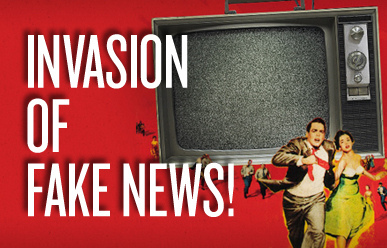
Homegrown political lies grow in the soil of racism, fertilized by liberal application of stupidity. Such was the anti-immigrant lie spread loud and wide by Michigan legislator Rep. Matt Maddock (R) who denounced the arrival of “illegal invaders” landing at a Michigan airport. But the dark-skinned people he saw and instantly hated on were not immigrants: they were the Gonzaga University basketball team, arriving in Detroit to play in a March Madness Sweet 16 game. The Hill reported:
“Happening right now. Three busses just loaded up with illegal invaders at Detroit Metro. Anyone have any idea where they’re headed with their police escort?” Maddock wrote on X, the platform formerly known as Twitter.”
Even after widespread exposure of his lie, Maddock refused to retract it, instead spewing more anti-immigrant hate.
Such stupid slanders flourish on social media, alongside more sophisticated propaganda from Russian government-connected actors.
Elaborate Russian propaganda and fake news spread through a network of phony news sites, often constructed to mimic legitimate media outlets. Two main aims appear: undermining U.S. support of Ukraine and promoting division and rightwing propaganda.
“Investigators say that firms working in the “Doppelgänger” network — and Russian intelligence agencies duplicating the tactics — are using the techniques to replicate and distort legitimate news sites in order to undermine continued aid to Ukraine.
“These techniques are subtle and far more skillful than what Russia attempted in 2016, when it made up Facebook posts or tweets in the names of nonexistent Americans, and used them to fuel protests over immigration or other hot-button issues.
“The loosely linked “Doppelgänger” creates fake versions of real news websites in the United States, Israel, Germany and Japan, among other countries. It often promotes websites previously associated with Russia’s military intelligence agency, known as the G.R.U.”
A March 7, 2024 NYT article on Russian “news” sites documents outright faked recordings and claims such as having “delivered Florida news since 1937.” Staff listings for the fake sites include names of people who have never heard of the sites. Some articles are lifted from real news organizations, to give a semblance of reliability.
“Into the depleted field of journalism in America, a handful of websites have appeared in recent weeks with names suggesting a focus on news close to home: D.C. Weekly, the New York News Daily, the Chicago Chronicle and a newer sister publication, the Miami Chronicle.
“In fact, they are not local news organizations at all. They are Russian creations, researchers and government officials say, meant to mimic actual news organizations to push Kremlin propaganda by interspersing it among an at-times odd mix of stories about crime, politics and culture. …
“The articles typically get hundreds of posts on a variety of platforms, including X, Facebook and Telegram, as well as Reddit, Gab and Truth Social, though it is difficult to measure the exact reach. Taken together, they could in theory reach thousands of readers, even millions.”
In addition to these phony “news” sites, Russian actors are hacking into U.S. government agencies and major companies. They are behind the recent attack that threw the nation’s pharmaceutical and health care billing system into chaos, as well as other ongoing attacks.
“Russia’s S.V.R., the intelligence agency that was most active in the 2016 election and that was behind the “SolarWinds” hack that gained entry to scores of government agencies and major American companies, has been in a monthslong attack on Microsoft. The effort appears aimed at gaining access to emails and corporate data. …
“Today, the hacking campaigns reap millions of dollars for criminal groups, while often serving the Kremlin’s agenda of disrupting American health care, government services and utilities.”
While other countries also try to interfere in U.S. elections, Russia is far and away the most active and effective actor. Their chosen presidential candidate is Donald J. Trump, though they will also target other U.S. campaigns.
Apart from Russian intervention, U.S. actors also spread lies and propaganda. Some—like the Trump campaign’s lies about Social Security and Medicare—appeal to fear and get traction through coverage on mainstream media. Others—like the lies about the Baltimore bridge collapse—spread mainly through social media.
After saying he might cut “entitlements” like Social Security and Medicare, Trump backpedaled and accused Democrats and migrants of “killing” the programs. The opposite is true: undocumented immigrants contribute billions of dollars every year to both programs although they are ineligible to collect from either. Instead of “killing” Social Security, undocumented immigrants prop up the program for the rest of the country.
The Baltimore bridge collapse was followed immediately by charges that it was somehow due to sabotage, immigrants, diversity programs, and the Biden administration. Irresponsible U.S. “news” sites go far beyond even the right-wing reporting of Fox News. Newsmax, a Trump favorite, is among the worst:
“During a Newsmax hit of his own, American Conservative Union Chairman Matt Schlapp suggested the container ship failure was somehow caused by “drug-addled” employees and covid lockdowns. Fox host Maria Bartiromo, meanwhile, linked the disaster to ‘the wide open border.’ …
“Conspiracy theories undermine faith in a shared truth or a shared community. MAGA isn’t really trying to get people to believe any one story. They’re just trying to sow doubt. If nobody can be trusted, if everyone is corrupt, then Trump and his ilk are no worse than anyone else. Conspiracy theories alienate people from the democratic process. …
“MAGA, in particular, is a movement built on stoking divisions and cultivating paranoid fear of Black people, immigrants, LGBT people, Muslims, Jews, and other marginalized people. Spreading conspiracy theories following disasters is a way to prevent the formation of solidarity, community, and trust.”
The narrator of a Vlog Brothers YouTube video describes four different misleading viral “facts” that they encountered online. These were mistakes from the left, which the narrator admits he was inclined to believe, although most misinformation comes from the right. The errors that led to this misinformation were all easily identified by a little investigation of the original sources. The narrator concludes:
“These are examples of varying fakeness of varying kinds. There’s a wrong graph. There’s cherry picked data, there’s a misattributed quote and a fact that doesn’t say exactly what it sounds like it said. I’ve heard the Internet referred to as a challenging information landscape.
“And like, yeah, yeah, I mean, I feel like I’m pretty good at this and I fail at it all the time. I will run to go fact check something that I disagree with and I will not do that with stuff that aligns with my previous conception of the world.
“That’s just going to be a bias that we all have to deal with and live with and work through. And yes, sometimes I feel like, what does it matter if somebody’s saying a graph is saying something that it isn’t actually saying, or that this graph is making people sort of active and excited and enthusiastic about making the kinds of change I want to see in my country, even if it’s not right, what does it matter?
“And I think a lot of people think that way, and I think a lot of people who disagree with me on a lot of topics definitely think that way. But for who I am and where I sit and what I do, I have to attempt to have a very strong alliance to the truth. And the incentives of like, the social Internet’s content recommendation systems make that hard for all of us. And I don’t know what to do about that– except to try very hard to have an alliance to the truth.”
“An alliance with the truth” sounds like a good prescription for any responsible citizen.
x x x
Note: I’ve written about fact checking, political lies, and media literacy many times over the past decade or so. While the specific stories that the posts refer to are dated, the basic advice on how to sort facts from lies remains good. Here are a few links to old posts:
“Fact. Wow!” Making sense of the news (January 31, 2017)
Lies, damn lies and Facebook lies: Update on phony news (October 37, 2016)
Don’t believe everything you read: Phony news and how to spot it (August 21, 2016)
Who can you believe? (January 14, 2016)
Also—Coursera still offers Making Sense of the News: News Literacy Lessons for Digital Citizens. You have to register with Coursera, but can audit the course without charge.
Discover more from News Day
Subscribe to get the latest posts sent to your email.
 Mary Turck