Category Archives: Uncategorized

Fishing for facts

Do the wealthiest 400 people in the United States actually earn more than the rest of us all put together? Yes, said a speaker at a recent forum in Minneapolis. Just one problem: like a fisherman describing the big one that got away, he didn’t get the facts quite right. The big fish—the large and growing income disparity between the extremely wealthy and the rest of us—is out there, but the numbers used to measure its weight and length are a little slippery.

In fact, the 400 wealthiest people in the United States own more of the nation’s wealth than the bottom 50 percent of the U.S. population. That’s different from what the speaker claimed in two ways:

1.     The difference between income and wealth: Income is what is earned in a year. Wealth or net worth is how much someone owns.

2.     The difference between “greater than all the rest of us” and “greater than the bottom 50 percent of the population.”

Michael Moore talked about the 400 wealthiest people at a Wisconsin protest. PolitiFact checked the original statement by Michael Moore, crunched numbers from half a dozen places, and found that the statement was true:

How could it be that 400 people have more wealth than half of the more than 100 million U.S. households?

Think of it this way. Many Americans make a good income, have some savings and investments, and own a nice home; they also have debt, for a mortgage, credit cards and other bills. Some people would still have a pretty healthy bottom line. But many — including those who lost a job and their home in the recession — have a negative net worth. So that drags down the total net worth for the poorer half of U.S. households that Moore cited.

I agree with the speaker that the widening disparity in distribution of wealth and income, and the increasing concentration of wealth and income in the hands of the top five percent or one percent or 400 people is an outrage and a disgrace to our nation.

Facts, like fish, are slippery things. If the length of a fish grows each time the story is told, no one really minds. When someone gets the economic or political facts wrong, they lose credibility and that hurts the rest of their message.

The question-and-answer portion of the forum provided more examples of problems with facts. An elderly African-American woman stood up to make a point about people sticking together and making sure that government works for all of us, but veered off-track.

“A lot of people are coming here free,” she said. “They can get health care free. A lot of people are coming over here. They are coming from other countries, getting this health care. The elderly, people like us, we are paying these big bucks for health insurance.

There are other people coming over, groups, whole nations, coming to this state and they’re getting health care free. You may not believe it, but I know it’s true.”

Well—it’s not true. And in the room full of activists and community members and public officials, not a single person challenged or corrected this firmly-held prejudice about immigrants.

The repetition of long-discredited myths about immigrants (or about African American people, welfare recipients, gay people, etc.) hurts more than the groups who are stereotyped. Not-quite-accurate or outright-false “facts” multiply and grow with each re-telling. Their proliferation in civic discussion pollutes the waters and that’s not good for any of us.

I wasn’t sure how to respond to the misstatements made this morning, and I’m still not sure. Part of the problem is that the statements are made in real time, and checking the facts to document the errors takes a little time.

Then there’s the question of whose “job” it is to correct the facts. Who should have answered these statements? How could they answer without seeming to be uppity authority figures or experts squashing the voice of a regular citizen?

I’m still fishing for answers to these questions.

1 Comment

Filed under Uncategorized

Who lives and works in Central Corridor area?

Central Corridor residents have lower incomes, higher unemployment, and pay a higher proportion of their income for housing costs, according to a set of studies released by the Healthy Corridors for All coalition on March 5. The studies explored the effect of city plans for rezoning and redevelopment along the Central Corridor route on residents. Continue reading

Leave a comment

Filed under Uncategorized

Unabashed civic promotion—St. Paul edition

Did you know that St. Paul is in the running to become a Fan Favorite among a Dozen Distinctive Destinations chosen by the National Trust for Historic Preservation? Well, now  you know—and you can help St. Paul win! “Vote for your favorite destination between February 15 and March 15,” the NTHP tells us, “and not only could your town become the 2011 Fan Favorite, but you will also be entered to win a two night stay at any Historic Hotel of America.” If that’s not enough incentive, consider this: right now, St. Paul is ranked number nine. That’s right, folks, we are NINTH out of twelve, trailing such notables as Paducah, Kentucky and Sheridan, Wyoming.  I don’t know about you, but that hurts my St. Paul pride. Vote early! Vote often! (Yes, you can vote once a day.) And you folks over in Minneapolis—lend us a hand, or at least a mouse-click-vote! Continue reading

Leave a comment

Filed under Uncategorized

Diabetes, bridges and aging Minnesota

Want to find out the percent of adults with diabetes in Fillmore County (7.8%) or the rate of deficient bridges (19.8%) in the county? How does that compare to diabetes rates (7.3% in Beltrami County, or to Beltrami’s bridge (6.8% deficient)? Minnesota Compass has answers to these and dozens of other questions in areas ranging from education and housing to population and income. Compass is part of the Wilder Foundation’s research arm. Continue reading

Leave a comment

Filed under Uncategorized

“Streamlining” endangers environment, takes away local control

Jim Falk, a fourth generation farmer from Swift County, warns that pending legislation billed as “streamlining” environmental protection actually endangers community rights and local control.

A whole set of proposed laws aims to streamline regulation, make bureaucracy move faster, cut the red tape are moving through the legislative process. Among the proposals: Continue reading

Leave a comment

Filed under Uncategorized

Who’s watching the kids?

Growing from a beginning focus on the Twin Cities in 2008, Minnesota Compass research now takes in the entire state. Its website describes its work as:

  • Providing unbiased, credible information
  • Tracking trends and measuring progress on issues that impact our quality of life.
  • Identifying disparities by including trend data by race, age, gender and income whenever possible.
  • Providing additional resources for addressing issues. Continue reading

Leave a comment

Filed under Uncategorized

Watch, witness, remember

I am watching Tahrir Square, live on Al Jazeera, and remembering 21 years ago, watching Tiananmen Square and the tanks moving in. This morning here/tonight there – ambulances are now being allowed in, troops are moving about, occasional rock-throwing appears, a government helicopter is circling the square, a petrol bomb (Molotov cocktail?) has been thrown toward the anti-government protesters … Continue reading

Leave a comment

Filed under Uncategorized

States, including Minnesota, have lower revenues due to recession

State government revenue dropped by about 30 percent from 2008 to 2009, according to the Census Bureau. That’s a huge drop, and much of it is attributed to the crash in investment income at the beginning of the recession.

The biggest hit came in what the Census Bureau calls “social insurance trust revenue.” That includes public employee retirement, unemployment compensation, workers compensation and other insurance trusts. For example – public employee retirement funds are invested in stocks and bonds. When the stock market crashed, so did the value of these funds. The drop in revenue for retirement funds does not mean that state  governments had less money to spend on day-to-day or even year-to-year operations, but rather than they have less money in reserve to pay pensions. Continue reading

Leave a comment

Filed under Uncategorized

“Strong Schools, Strong Communities” plan proposed for St. Paul schools

With a $27 million shortfall in 2010 and a looming $20 million shortfall in 2011, St. Paul schools have been faced with hard choices. The response, presented by Superintendent Valeria Silva on Tuesday, January 11, is a three-year strategic plan called “Strong Schools, Strong Communities,” placing “schools at the heart of the community.” The plan will now go to six community meetings (see sidebar), and then to a school board vote on March 15. Continue reading

Leave a comment

Filed under Uncategorized

“We need to do a little soul searching”

I remember where I was on November 22, 1963. And on April 4, 1968. And on September 11, 2001. Today, January 8, 2011 is another date that will live in American memory. Like the other acts of assassination and terror, today’s shooting in Arizona was an attack on all of us, an attack on the country and on the practice of democracy.

Today Congressmember Gabrielle Giffords held another of the evens she calls Congress on Your Corner, a very open meeting with constituents in a grocery store parking lot. And then the shooting started.

According to Reuters, the sheriff’s office in Tucson says 18 people were shot, six of them fatally. Jared Loughner, age 22, was arrested. Congressmember Gabrielle Giffords was shot in the head and remains in critical condition. Reuters quotes her surgeon as being “very optimistic” about her recovery, though the doctor describes her wound as “through-and-through … It went through her brain.”

Those who were killed included a nine-year-old child and Federal Judge John Roll.

Both Roll and Giffords had previously received threats over political stands.

Was the shooting in Arizona the work of a right-wing crazy? Or just a plain old crazy? Or someone whose craziness was channeled and directed by the hate speech that permeates what passes for public discourse today?

Sarah Palin listed Giffords on her “targets” list during the 2010 campaign. We are told that had nothing to do with today’s shooting, because violent speech has nothing to do with violent actions. That’s the right-wing mantra today, and that was the right-wing mantra last year, when Giffords’ office was attacked.

After she voted for health care reform last year, Giffords received death threats and her office windows were broken. The Washington Post reported in March on a right-wing former militia member’s call to break windows of health care reform supporters:

“So, if you wish to send a message that Pelosi and her party [that they] cannot fail to hear, break their windows,” Vanderboegh wrote on the blog, Sipsey Street Irregulars. “Break them NOW. Break them and run to break again. Break them under cover of night. Break them in broad daylight. Break them and await arrest in willful, principled civil disobedience. Break them with rocks. Break them with slingshots. Break them with baseball bats. But BREAK THEM.”

In the days that followed, glass windows and doors were shattered at local Democratic Party offices and the district offices of House Democrats from Arizona to Kansas to New York. At least 10 Democratic lawmakers reported death threats, incidents of harassment or vandalism at their offices over the past week, and the FBI and Capitol Police are offering lawmakers increased protection.

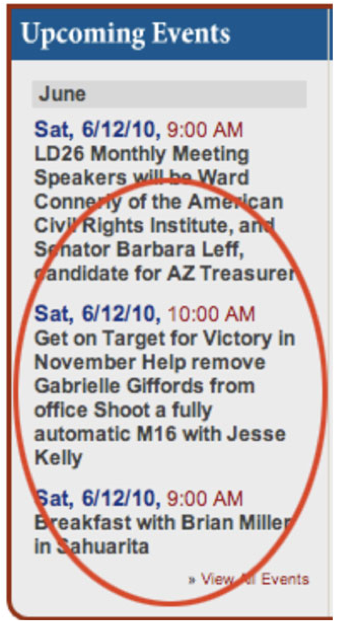
Giffords’ 2010 opponent scheduled a campaign event that invited supporters to “Help remove Gabrielle Giffords from office. Shoot a fully automatic M16 with Jesse Kelly.”

That kind of innuendo clearly has no impact on people like the one who shot up the democratic gathering today. Those shots were not fired from a fully automatic M16. Today’s shooter reportedly used a Glock. No connection at all.

James Fallows, writing in his Atlantic blog, reminds us: “”Shootings of political figures are by definition ‘political.’ That’s how the target came to public notice; it is why we say ‘assassination’ rather than plain murder.”

Giffords told MSNBC: “We’re on Sarah Palin’s targeted list, but the thing is, that the way that she has it depicted has the crosshairs of a gun sight over our district. When people do that, they have to realize that there are consequences to that action.”

Consequences? Today, after the shooting, the crosshairs graphic (above) was finally taken down from Palin’s website.

The Congress on Your Corner events have been a regular feature of Giffords’ outreach to constituents. Aides called police last year after someone dropped a gun on the ground at a 2009 Congress on Your Corner at a Safeway in Douglas, AZ. They were worried about her safety. But part of a representative’s job is meeting with the people she represents. Congress on Your Corner continued.

Judge John Roll was killed today. He, too, had been targeted with physical threats for political reasons. Judge Roll was no flaming liberal – he was appointed to the federal bench by President George H.W. Bush. But he became a target of  anti-immigration activists. He and his family spent a month under 24-hour protection by federal marshals in 2009, due to the all-too-credible threats against him, according to the Washington Post.

Pima County Sheriff Clarence W. Dupnik (quoted in Bob Collins’ NewsCut blog on MPR) knew both Judge Roll and Congressmember Giffords:

I never met a more sincere, brilliant, fair-minded judge in my life. He goes to mass daily and he was going to go home and do the floors as he did every Saturday.

Congresswoman Giffords is brilliant. She’s not about Democrats or Republicans. She’s not about politics. All she cares about is the United States of America.

Sheriff Dupnik spoke for many of us:

Today, I hope all Americans are as saddened as shocked as we are. I hope some of them are as angry as I am. I think it’s time as a country that we need to do a little soul searching. The vitriolic rhetoric that we hear day in and day out by people in the radio business and some in the TV business, this has not become the nice United States of America that we grew up in.

And back to James Fallows:

It is legitimate to discuss whether there is a connection between that tone and actual outbursts of violence, whatever the motivations of this killer turn out to be. At a minimum, it will be harder for anyone to talk — on rallies, on cable TV, in ads — about “eliminating” opponents, or to bring rifles to political meetings, or to say “don’t retreat, reload.”

1 Comment

Filed under Uncategorized