I wrote in another post about the legalities of the Zimmerman acquittal and what might come next, but I am having a much harder time writing about Trayvon Martin. Continue reading
Thinking legally about the Zimmerman verdict
The not guilty verdict leaving George Zimmerman free of any criminal liability for killing Trayvon Martin demonstrates the limits of law in achieving justice. Like the drug dealer going free because of an illegal search or the hit man walking away because witnesses are too terrified to testify, Zimmerman goes free because the law sometimes protects those who are morally guilty as sin. Continue reading
Filed under Uncategorized
Obesity solution: Better junk food or food justice and urban farming?
Junk food can end obesity insists David Freedman in the current edition of The Atlantic. He also maintains that poor people are more obese and that they can’t/won’t eat fruits, vegetables and other wholesome foods. Thus: better junk food is the healthy solution for poor people.
Really? I have a few choice words for Mr. Freedman, but better than my words — let’s take a look at people who are working to provide a different answer, in poor neighborhoods and inner cities.
LaDonna Redmond started working for food justice as a mother on the West Side of Chicago, living in what some people call “food deserts” without much access to organic or non-processed food — the kind of neighborhood that Freedman believes is unwilling/incapable of choosing vegetables over McDonalds. Freedman insists that this kind of neighborhood will benefit from “healthier junk food,” as exemplified by McDonald’s egg-white breakfast sandwich, with 50 fewer calories than the Egg McMuffin.
Redmond’s vision is a whole lot bigger. “My husband and I started urban farming in our backyard and it grew from getting vacant lots to developing urban farm sites and selling food at farmers markets,” she told Minnesota Women’s Press in an interview this year. “That was the beginning of my work of rebuilding local food systems, first around my neighborhood and now around the country.”
Redmond advocates for what she calls food justice:
“It’s about knowing where your food comes from, knowing who grew the food, under what conditions and to what degree those products are healthy for the land.
“Is it healthy for your body and healthy for the planet? Is it healthy for the people who are enslaved by the food system, people who are forced to work for pennies so that we can have tomatoes, when they cannot afford to buy those same tomatoes? Knowing just a little more about food might slow some people down when they are eating highly processed foods.”
Freedman scoffs at the idea that what he calls “the obese masses” can move away from junk food. He believes that only “a small, elite minority” can be interested in healthy food, and that
“… there is no reasonable scenario under which these foods could become cheap and plentiful enough to serve as the core diet for most of the obese population—even in the unlikely case that your typical junk-food eater would be willing and able to break lifelong habits to embrace kale and yellow beets.”
Instead of kale and beans, Freedman says we should move toward “high-tech anti-obesity food engineering” that would feed poor people better junk food — like a Burger King turkey burger that’s 100 calories better than a Whopper.
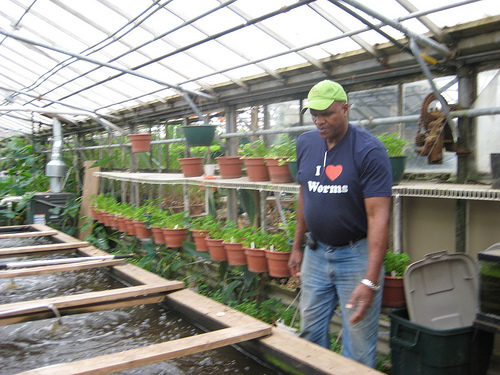
Photo of Will Allen by grifray, Creative Commons license
Like LaDonna Redmond, Will Allen has a diametrically different vision of food for poor people. His organization, Growing Power, has worked for 20 years to develop urban farming in Milwaukee and Madison and Chicago, as well as distributing food grown through a network of 300 small family farms. On his website, Allen says, “If people can grow safe, healthy, affordable food, if they have access to land and clean water, this is transformative on every level in a community. I believe we cannot have healthy communities without a healthy food system.”
Right here in Minneapolis, Project Sweetie Pie helps inner-city kids grow their own food. During the 2013 summer, “These young people will be going around to about 30 different gardens to be sure that they are weeded, watered and vibrant. Along the way, they will be learning how to design, plant, and maintain gardens, sell produce, figure out the cost of gardening, and learning about techniques.”
Project Sweetie Pie in action (Photo from website)
In her TedX talk (video above), LaDonna Redmond talks about the intersection of civil rights and food justice. Will Allen and Project Sweetie Pie and a whole long list of activists back to the Black Panther Party breakfast program get it. Maybe The Atlantic should ask them about ending obesity and food justice.
Filed under Uncategorized
Damsel in distress — video games and real life
Anita Sarkeesian has a great analysis of the use of the “damsel in distress” trope in video games. With one example after another, she indicts the popular culture depictions of victimized women who need to be rescued by strong men. (Knight in shining armor, anyone?) Sarkeesian explains that these “disposable women” are vehicles for showing the strength/heroism/courage of the men who are the only players with agency.
Sarkeesian names a classic victimized woman: the “woman in the refrigerator” who has already been killed, leaving the hero to take violent and bloody pursuit of the evil-doers who have killed his wife or daughter. She recites a litany of examples of the Fridge/Damsel hybrid: “Your wife is brutally murdered and then you have to rescue your daughter.”
Sarkeesian is talking about violence, and about the cultural centrality of violence against women: “Even though most of the games that we are talking about don’t explicitly condone violence against women, nevertheless they trivialize and exploit female suffering as a way to ratchet up the emotional or sexual stakes for the player.”
These are strictly male-centered stories. Women are portrayed as “symbols meant to invoke the essence of a feminine ideal,” which includes “purity, beauty, kindness, sensuality.” The death or kidnapping or violation of a woman is the loss of the property of the hero.
Destructive, anti-woman tropes, of course, go far beyond video games, and there are plenty of other tropes that disempower women, such as the classic Disney princess.

Lots of writing about Disney princesses, including this and this and this, and a totally teen take: What Disney princesses taught me about being a lady. Sometimes, of course, a picture is worth a thousand words:

From Feministing.
Sarkeesian’s analysis of video game violence against women and the Disney critics’ analysis of the princess-ification of women present legitimate and convincing cultural critiques.
The critiques go beyond representations on various sizes of screens. Sarkeesian places the video games in the larger cultural context of violence against women, citing the horrific statistics about how a woman is assaulted or beaten every nine seconds in the United States, and, on average, more than three women are murdered by their husbands or boyfriends every day.
Actual violence is a huge part of the equation. Even more widespread, indeed, almost universal, is the experience of victimization, of feeling threatened, of staying at home, or going out only in groups, of watching over your shoulder and hearing every footstep behind you on the street, because you need to, for safety and survival.
While male characters in video games defend “their” women, their girlfriends and wives and daughters, so do men in real life, whether by physical action or just by being there, by implicitly or explicitly signaling other men that this is “my woman, wife, daughter, sister.”
Is it a good thing to defend someone against attack? Yes — and, objectively, we can understand male feelings of pride in defending a friend or loved one.
Is it a bad thing to be under attack and to have to be defended by someone else? Yes, again. And we should also understand feelings of both anger at the men who are attackers and resentment at those who are rescuers, because we should not need rescue. (And because, in fact, “being rescued” can also take away the opportunity to demonstrate that we can take care of ourselves.)
Near the beginning of her video, Sarkeesian says: “Please keep in mind that it’s both possible and even necessary to simultaneously enjoy a piece of media while also being critical of its more problematic or even pernicious aspects.”
From Jane Austin to video games, that’s a good piece of advice. Might even have some non-media applicability to interpersonal interactions.

Filed under Uncategorized
Voting Rights and wrongs
Just got off an informational telephone briefing from NAACP national leaders on the Shelby County vs. Holder decision. What a depressing development! What I take away from today’s decision and discussions: the struggle to defend voting rights is going to intensify at the state and local levels, since there’s no way that Congress will act, even though the Supreme Court left it wide open for them to do so. (I heard a comment this morning on NPR discussion, to the effect that the only thing Congress can agree on is naming post offices — sounds about right.)
At the state and local levels, there will be struggles over restrictive voting provisions, including:
- efforts to make it more difficult to register;
- voter ID requirements;
- making it difficult to vote through mechanisms such as fewer polling places, meaning longer distances to travel and longer lines and wait times;
- purges of voting rolls (already tried last year in Florida, and stopped through the Voting Rights Act)
All of which makes local vigilance, legislative elections and state Secretary of States’ offices more important than ever.
The NAACP theme for the national convention this year: We shall not be moved. This year is the 50th anniversary of the assassination of Medgar Evers, who lived and died working for voter rights.
Filed under Uncategorized
Mother’s Day dinner, then and now
I remember when Mother’s Day dinner for our very large family meant the A&W drive-in. Mother and Dad piled all of us in the station wagon and we feasted on California burgers and root beer. I know finances had a lot to do with it, but I bet that keeping all of us corralled in a car instead of running loose in a restaurant was also a factor in the dining decision. Continue reading
Filed under Uncategorized
The elephant in higher education
There’s a folk tale, variously attributed to India, China and Africa, about blind men describing an elephant. One feels the trunk and says the animal is like a snake. Another feels the leg, and describes the elephant as like a tree. And so on. The varying emphases of recent articles about for-profit higher education reminded me of that story. Continue reading
Filed under Uncategorized
A long path to citizenship, with plenty of roadblocks on the way
Quartz.com has an infographic that sums up the Senate immigration bill’s provisions for a “path to citizenship”. It’s pretty depressing. According to the analysis, the path to citizenship for most immigrants currently in the United States without legal status would be a minimum of 13 years. Doesn’t sound too bad? Wait — there’s more. Continue reading
Filed under Uncategorized
Land of 10,000 lakes — and not enough water
Think the end of the drought means no water problems? Think again. In lots of places, we are over-using groundwater, and the situation is getting worse by the year, if not by the month. That means more disappearing lakes and shorelines and, potentially, shortages in drinking water ahead, even in water-rich Minnesota. Continue reading
Filed under Uncategorized
Quacks, frauds and profiteers rake in the dollars for fake science
Dr. Oz leads the pack. He’s a real doctor, with a real Harvard degree, who endorses fake medicine all over the airwaves. A recent article on Slate debunked some of his more fantastic recent claims, presented on his TV shows, and promptly amplified by manufacturers of products like “garcinia extract.” The authors write: Continue reading
Filed under Uncategorized