
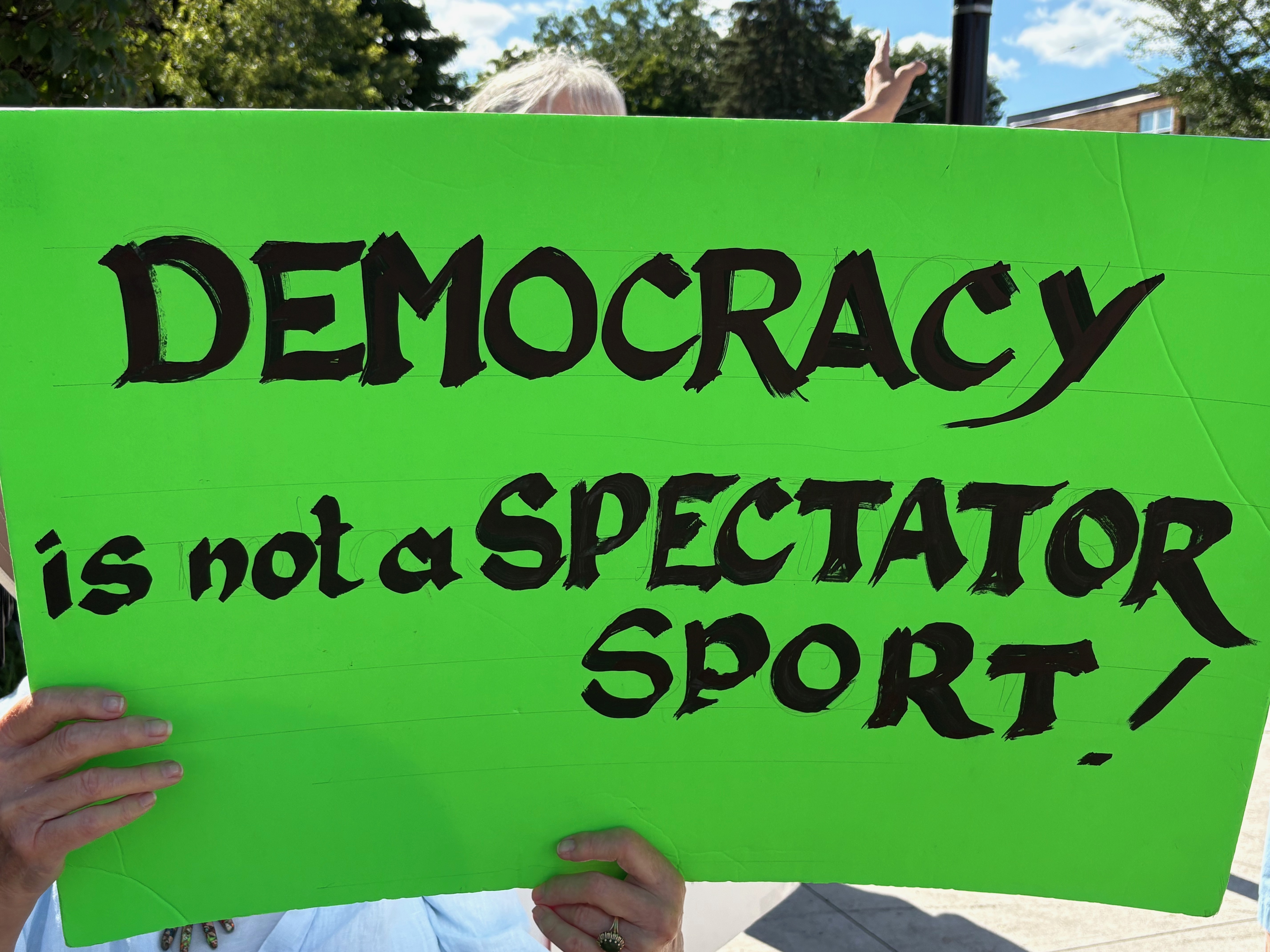
Will your vote still count in 2026 or in 2028? Trump’s attacks on elections go beyond anything that has been attempted in the United States. He even told Reuters news service in an interview: “When you think of it, we shouldn’t even have an election.”
This post has:
- a list of some of the attacks on voting and elections, with very brief description and links to longer explanations;
- brief summary of ongoing lawsuits and other actions in defense of elections; and
- steps you can take now to be sure your vote counts.
The Attacks
Many of the attacks on elections are detailed in Trump’s March executive order, which orders the Department of Homeland Security to create a state citizenship list, the postal service to restrict mail-in voting, and the attorney general to prosecute state and local election officials. Trump’s order ignores the Constitution, which entrusts voting procedures to the states and, to a more limited degree, to Congress. The Constitution gives the executive branch NO power over elections.
Private voter information: Trump’s executive order demands that states turn over all voter information, including social security numbers and other personal identification, to the Department of Homeland Security (DHS). That would violate state and federal privacy laws. Minnesota is among two dozen states refusing to do so.
Trying to end voting by mail: Trump ordered the U.S. Postal Service to refuse to deliver mail-in ballots in states that refused to comply with his illegal order to turn over all state voter registration information to DHS.
Withdrawing federal election assistance funds: Republicans in Congress are trying to bar states that protect citizen privacy from receiving these funds, which mainly go to beef up election security. Minnesota Representatives Pete Stauber, Tom Emmer, Michelle Fischbach, and Brad Finstad are co-sponsoring the bill.
Destroying the federal Election Assistance Commission: The Election Assistance Commission, established in 2002, provides assistance to states, serves as a national clearinghouse of information on election administration, accredits testing laboratories, certifies voting systems, and maintains the national mail voter registration form. The commission has two Democratic and two Republican members. Or it did—until Trump fired the two Democratic members in early July and the one remaining Republican resigned. (The other Republican member resigned in 2025.)
Gutting the Voting Rights Act: In 2013, the Supreme Court struck down the section of the Voting Rights Act that required states with a history of blocking Black voters to get preclearance of any changes to their voting laws. The majority said that racial discrimination was no longer a problem—those states quickly showed that it is. This year, the Court went even further, in a ruling that basically allows racial discrimination in redistricting.
Redistricting to dilute the voting power of minorities and Democrats: Normally, redistricting takes place after a census. That means redrawing district lines for Congressional districts and state legislative districts to ensure equal representation by population. Beginning last year, Republicans made a major push to redistrict in the middle of the ten-year period—not in order to equalize population between districts, but in order to give Republicans more seats in Congress and state legislatures. Democrats in some states have responded in kind, but the vast majority of the partisan redistricting favors Republicans. [Historical background of partisan gerrymandering here.]
Threatening state election officials: The Department of Justice, on orders of the president, sent letters to election officials in all states and the District of Columbia threatening criminal prosecution over noncitizen voting—a vanishingly rare occurrence.
Withholding FEMA funding: FEMA told states that it will withhold some terrorism-preparedness grants unless they comply with demands to transition to paper ballots and make other changes ordered by the Trump administration.
Threatening election security: Normally, federal intelligence officials brief state officials on any potential threats to upcoming elections. Not this year. Instead, state officials face the real possibility of federal law enforcement or ICE agents being ordered to polling places.
Proposed Legislation: Trump is pushing hard for Congress to pass voting restrictions, including a requirement that all voters show official evidence of citizenship, such as a birth certificate or passport in their name. Among those potentially disenfranchised by this proposal: married women, whose name is different than that on their birth certificate, elderly citizens who do not have birth certificates or the time and resources to obtain them from distant birthplaces; anyone who cannot afford the time to obtain and the money to pay for a birth certificate ($26 in Minnesota) or passport (minimum cost of $130). Fortunately, that proposal seems unlikely to pass.
Defending Elections
Multiple lawsuits have challenged the March executive order on elections.
On June 25, a federal judge in Massachusetts blocked the U.S. Postal Service’s planned changes to delivery of mail-in ballots, and also blocked other parts of Trump’s March executive order. On July 1, a federal judge in Washington blocked the U.S. Postal Service from making changes to delivery of mail-in ballots.
A federal judge in New Hampshire dismissed a DOJ lawsuit trying to get New Hampshire voting rolls, a ruling welcomed by New Hampshire’s Republican secretary of state. DOJ has lost similar cases in ten other states.
The Trump administration has also tried to give states access to the DHS Systematic Alien Verification for Entitlements database, which is used by government agencies in determining eligibility for various programs and licenses. Two judges in different states have made opposing rulings on whether this is legal.
Trump’s attacks on election integrity are based on lies. His claims of non-citizen voting are unfounded: the conservative Heritage Foundation found only 99 such cases in the past 25 years in the entire country.
The Supreme Court ruled against efforts to overturn state laws allowing mail ballots postmarked on or before Election Day to be counted even if they are received after Election Day.
In Minnesota: The Office of the Legislative Auditor reported in July 2026 that “Counties followed the identity verification process correctly for 99.9 percent of applicants,” while also noting that some counties need to update voter registration records in accord with information furnished by the Secretary of State.
Minnesota is also testing the accuracy of voting machines, beginning in July, as it does before every election. The tests are open to the public and must be observed by at least two election judges, including one from each party.
Making Sure Your Vote Counts
New executive orders can issue at any time. Court cases get appealed, overturned, appealed again. What can you do to make sure your vote counts?
First—Check your voter registration. Sometimes registrations are challenged or purged. That happens less often in Minnesota, but it’s still a good idea to check, and very simple to do. Just go to https://mnvotes.sos.mn.gov. Or type mnvotes into your browser: that will get you there. After you check your registration, you will see “Looking for more information?” and links to see the races on your ballot and directions to your polling place.
Second —Vote early and in person. That ensures that no election day surprises from Trump and his minions can stop you from voting.
Third—Get involved. Help other people to register and vote. Counter lies and misinformation with good information.
This is our country. As long as we keep on defending it.
Discover more from News Day
Subscribe to get the latest posts sent to your email.
 Mary Turck