News Day, written by Mary Turck, analyzes, summarizes, links to, and comments on reports from news media around the world, with particular attention to immigration, education, and journalism. Fragments, also written by Mary Turck, has fiction, poetry and some creative non-fiction.
Mary Turck edited TC Daily Planet, www.tcdailyplanet.net, from 2007-2014, and edited the award-winning Connection to the Americas and AMERICAS.ORG, in its pre-2008 version. She is also a recovering attorney and the author of many books for young people (and a few for adults), mostly focusing on historical and social issues.
In Egypt today (Wednesday, February 2), the government sent police and government employees and supporters to attack the demonstrators assembled in Tahrir Square in Cairo. The army, which has not attacked the demonstrators, did not intervene to safeguard them from the attackers, some of whom came on horseback and camelback. Many people were seriously injured and at least one killed. The U.N. Secretary General condemned the violence.
The mainstream media, for the most part, are not reporting the identity of attackers – that they are police and government supporters, armed and sent by the government.
If you are watching the news from Egypt, whether with hope for the future or with fears resonating from Mexico in 1968 or Tiananmen Square, Democracy Now is the prime go-to news source. Their Sharif Abdel Kouddous is reporting from Cairo, where his family lives, and you can follow him via his Twitter stream (@sharifkouddous) or on the Democracy Now blog, which includes other voices as well.
Then there’s Al Jazeera, whose credibility is attested to by the ferocity with which the Egyptian police and government supporters are attacking it.
State government revenue dropped by about 30 percent from 2008 to 2009, according to the Census Bureau. That’s a huge drop, and much of it is attributed to the crash in investment income at the beginning of the recession.
The biggest hit came in what the Census Bureau calls “social insurance trust revenue.” That includes public employee retirement, unemployment compensation, workers compensation and other insurance trusts. For example – public employee retirement funds are invested in stocks and bonds. When the stock market crashed, so did the value of these funds. The drop in revenue for retirement funds does not mean that state governments had less money to spend on day-to-day or even year-to-year operations, but rather than they have less money in reserve to pay pensions. Continue reading →
A report last week from Minnesota health plan companies, Minnesota’s Healthcare Imperative, recommended cuts in services for people with disabilities, and “a fundamental reinvention of the payment system.” In plain English, that means that state Medicaid payments, which now go directly to doctors and health care providers, would instead go to insurance companies and other managed care groups. Continue reading →
“Three years ago, I met a young girl, now eight years old, whom I will call Sara. And who, when placed with foster parents at the age of five, couldn’t count beyond three and didn’t know her alphabet.”
Carolyn Roby, a high-powered Wells Fargo Foundation executive, had trouble talking about Sara at the January 26 Compass annual meeting. Her voice broke as she described Sara’s background – no learning disabilities, just an impoverished environment as the youngest of 10 children in a single-parent family where English was not the home language. Continue reading →
With a $27 million shortfall in 2010 and a looming $20 million shortfall in 2011, St. Paul schools have been faced with hard choices. The response, presented by Superintendent Valeria Silva on Tuesday, January 11, is a three-year strategic plan called “Strong Schools, Strong Communities,” placing “schools at the heart of the community.” The plan will now go to six community meetings (see sidebar), and then to a school board vote on March 15. Continue reading →
I remember where I was on November 22, 1963. And on April 4, 1968. And on September 11, 2001. Today, January 8, 2011 is another date that will live in American memory. Like the other acts of assassination and terror, today’s shooting in Arizona was an attack on all of us, an attack on the country and on the practice of democracy.
Today Congressmember Gabrielle Giffords held another of the evens she calls Congress on Your Corner, a very open meeting with constituents in a grocery store parking lot. And then the shooting started.
According to Reuters, the sheriff’s office in Tucson says 18 people were shot, six of them fatally. Jared Loughner, age 22, was arrested. Congressmember Gabrielle Giffords was shot in the head and remains in critical condition. Reuters quotes her surgeon as being “very optimistic” about her recovery, though the doctor describes her wound as “through-and-through … It went through her brain.”
Those who were killed included a nine-year-old child and Federal Judge John Roll.
Both Roll and Giffords had previously received threats over political stands.
Was the shooting in Arizona the work of a right-wing crazy? Or just a plain old crazy? Or someone whose craziness was channeled and directed by the hate speech that permeates what passes for public discourse today?
Sarah Palin listed Giffords on her “targets” list during the 2010 campaign. We are told that had nothing to do with today’s shooting, because violent speech has nothing to do with violent actions. That’s the right-wing mantra today, and that was the right-wing mantra last year, when Giffords’ office was attacked.
After she voted for health care reform last year, Giffords received death threats and her office windows were broken. The Washington Post reported in March on a right-wing former militia member’s call to break windows of health care reform supporters:
“So, if you wish to send a message that Pelosi and her party [that they] cannot fail to hear, break their windows,” Vanderboegh wrote on the blog, Sipsey Street Irregulars. “Break them NOW. Break them and run to break again. Break them under cover of night. Break them in broad daylight. Break them and await arrest in willful, principled civil disobedience. Break them with rocks. Break them with slingshots. Break them with baseball bats. But BREAK THEM.”
In the days that followed, glass windows and doors were shattered at local Democratic Party offices and the district offices of House Democrats from Arizona to Kansas to New York. At least 10 Democratic lawmakers reported death threats, incidents of harassment or vandalism at their offices over the past week, and the FBI and Capitol Police are offering lawmakers increased protection.
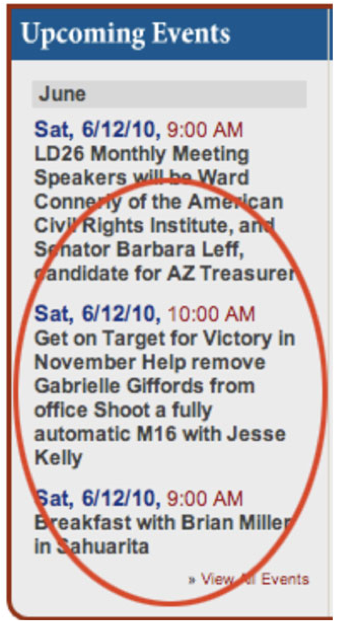
Giffords’ 2010 opponent scheduled a campaign event that invited supporters to “Help remove Gabrielle Giffords from office. Shoot a fully automatic M16 with Jesse Kelly.”
That kind of innuendo clearly has no impact on people like the one who shot up the democratic gathering today. Those shots were not fired from a fully automatic M16. Today’s shooter reportedly used a Glock. No connection at all.
James Fallows, writing in his Atlantic blog, reminds us: “”Shootings of political figures are by definition ‘political.’ That’s how the target came to public notice; it is why we say ‘assassination’ rather than plain murder.”
Giffords told MSNBC: “We’re on Sarah Palin’s targeted list, but the thing is, that the way that she has it depicted has the crosshairs of a gun sight over our district. When people do that, they have to realize that there are consequences to that action.”
Consequences? Today, after the shooting, the crosshairs graphic (above) was finally taken down from Palin’s website.
The Congress on Your Corner events have been a regular feature of Giffords’ outreach to constituents. Aides called police last year after someone dropped a gun on the ground at a 2009 Congress on Your Corner at a Safeway in Douglas, AZ. They were worried about her safety. But part of a representative’s job is meeting with the people she represents. Congress on Your Corner continued.
Judge John Roll was killed today. He, too, had been targeted with physical threats for political reasons. Judge Roll was no flaming liberal – he was appointed to the federal bench by President George H.W. Bush. But he became a target of anti-immigration activists. He and his family spent a month under 24-hour protection by federal marshals in 2009, due to the all-too-credible threats against him, according to the Washington Post.
Pima County Sheriff Clarence W. Dupnik (quoted in Bob Collins’ NewsCut blog on MPR) knew both Judge Roll and Congressmember Giffords:
I never met a more sincere, brilliant, fair-minded judge in my life. He goes to mass daily and he was going to go home and do the floors as he did every Saturday.
Congresswoman Giffords is brilliant. She’s not about Democrats or Republicans. She’s not about politics. All she cares about is the United States of America.
Sheriff Dupnik spoke for many of us:
Today, I hope all Americans are as saddened as shocked as we are. I hope some of them are as angry as I am. I think it’s time as a country that we need to do a little soul searching. The vitriolic rhetoric that we hear day in and day out by people in the radio business and some in the TV business, this has not become the nice United States of America that we grew up in.
It is legitimate to discuss whether there is a connection between that tone and actual outbursts of violence, whatever the motivations of this killer turn out to be. At a minimum, it will be harder for anyone to talk — on rallies, on cable TV, in ads — about “eliminating” opponents, or to bring rifles to political meetings, or to say “don’t retreat, reload.”
Rally for fired Chipotle workers (photo by Sally Jo Sorenson)
Langston Hughes understood dreams, those deferred and those denied. For too many immigrants, the American dream “sags, like a heavy load,” heavier now because of the double blows of the defeat of the DREAM Act and the Obama administration’s unrelenting pursuit of undocumented immigrant workers in the workplace.
Chipotle workers marched in Minneapolis last week, protesting recent firings attributed to Immigration and Customs Enforcement (ICE) pressure on their employer to clear the payroll of any possibly-undocumented workers. The tool ICE uses is workplace audits, which have pushed deportation numbers to a record high this year. The timing of the Chipotle workers’ firing—after training in non-Latino replacement workers and before receiving long-awaited Christmas bonuses—tasted particularly bitter.
Our immigration system is broken. Despite the incessant repetition of “why don’t they just get in line to immigrate legally?” the truth remains: there is no line. There is no application for an undocumented worker to file, no line to stand in, no way of ever obtaining legal permission to live and work here. There is no legal immigration route for the millions of undocumented U.S. workers. There is no legal immigration route for the high school students whose parents carried them across the border when they were infants or toddlers. There is no way
Comprehensive immigration reform is needed, but comprehensive immigration reform has been blocked for years. Even back in the day when Senator John McCain supported it, comprehensive immigration reform never got close to passage. So the Obama administration, though promising to prioritize immigration reform, decided to seek Republican support by imposing a hardline enforcement and deportation regime.
Rather than focusing its enforcement efforts on finding and deporting criminals, ICE went after workers. Reporting on record deportation numbers, MPR talked to John Keller, director of the Immigrant Law Center of Minnesota:
“What we think is happening is that ICE itself is continuing to want to show an increase in the number — the raw number — of people that it’s removing from the United States,” Keller said. “And the only way they can do that is by getting the easiest people that fall into their laps.”
The DREAM Act would have offered a circumscribed, on-your-best-behavior opportunity to become legal residents to a limited number of young people. Young people brought to the United States before the age of 16 who have lived here for more than five years and then attended college or served in the military would have qualified to apply for legal residence. Even that was voted down by a Senate that is hamstrung by filibuster rules.
In a July interview, John Keller warned about a growing credibility gap for the president on immigration. He suggested that the president could take some executive actions even if he could not get comprehensive immigration reform through Congress, such as granting deferred enforced departure (DED) to students who would come under proposed DREAM Act provisions.
“It is heartbreaking,” President Obama said of the failure of the Senate to pass the legislation, which would provide a path to citizenship for children brought to the country illegally if they serve in the military or attend college. “The kids are going to school, like any other American kid. They’re growing up. They’re playing football. They’re going to class. They’re dreaming about college. And suddenly, they come to 18, 19 years old, and they realize, ‘Even though I feel American, I am an American, the law doesn’t recognize me as an American. I’m willing to serve my country. I’m willing to fight for this country. I want to go to college and better myself, and I’m at risk of deportation.’“One thing I hope people have seen during this lame duck: I am persistent,” the president said. “I am persistent. You know, if I believe in something strongly, I stay on it. And I believe strongly in this.”
Though a handful of Democrats also played a role in defeating the DREAM Act, the president said he would engage on immigration reform with Republicans whom, he said, “in their heart of hearts, know it’s the right thing to do, but they think the politics is tough for them. Well, that may mean that we’ve got to change the politics and I’ve got to spend some time talking to the American people.”
The president is not the only one who can act. In that July interview, Keller issued a call to action to all who care about immigrants and immigration reform:
“If we give in to the political calculations that the president repeated today, that we can’t do anything unless the Republicans join us, it saps our commitment and energy … It turns our back on the very people who are too vulnerable to raise their voices and who are counting on us to fix this issue for this generation. I would challenge anybody who’s frustrated and angered by the lack of action out of Washington to channel that into positive phone calling, conversations with neighbors, working with faith communities, unions, professional associations, Minnesota’s business and other employment-based associations, etc.”
Walk a mile in Minnesota winter? Carrying a baby or groceries? No problem, thought the Central Corridor planners. Then the Stops for Us coalition gave a voice to the folks who live and walk or take the bus home along University Avenue. Because of their efforts, the Hamline, Victoria and Western stops on the Central Corridor line were added to serve the people living in the heart of the Frogtown and Summit-University neighborhoods. On December 15, the federal Environmental Protection Agency recognized the work of Stops for Us, naming it one of five winners of the 2010 Environmental Justice awards
for its efforts to form a broad-based partnership to secure the construction of three new light rail transit stations, which will provide access for the transit dependent communities of East University Avenue and connect residents to housing, jobs, education, and the many amenities located throughout the Twin Cities metropolitan region.
The coalition’s members include:
Alliance for Metropolitan Stability
Asian Economic Development Association
Aurora St. Anthony Neighborhood Development Corporation
Community Stabilization Project
District Councils Collaborative of St. Paul and Minneapolis
Got Voice, Got Power!
ISAIAH
Jewish Community Action
Minnesota Center for Environmental Advocacy
Transit for Livable Communities
UFCW Local 789
The official award describes the work of Stops for Us partners:
The Central Corridor Light Rail Transit Project, a nearly $1 billion investment connecting downtown St. Paul and downtown Minneapolis, will provide improved transit service through the heart of the region, particularly for residents living in environmental justice neighborhoods located along the planned route. Construction of the three light rail transit stations will directly benefit the 8,331 people who live within a quarter mile of the stations (81% minority; average median household income for homes near the three stations is $32,000). The Coalition worked extensively to: influence public officials; research station spacing; map demographics; participate in and leverage to the fullest extent possible the National Environmental Policy Act process; draft state legislation; monitor public meetings; testify at public hearings; and implement a media strategy. Moreover, the Coalition has been able to establish a Central Corridor Community Agreements Coordinating Committee to ensure equitable community benefits from related development.
A press release from Stops for Us cites ongoing issues that remain, including “to help small businesses survive, preserve an adequate supply of affordable housing, and enable low- and fixed-income residents to stay in place.”
An awards ceremony is being planned for the Twin Cities in 2011.
Housing Link, a nonprofit clearinghouse for affordable housing information, issued a report highlighting the housing gap. Its key findings:
151,788 metro-area households had incomes of less than 30 percent of the area median income. According to the report, that’s considered “extremely low income” by HUD.
Only 50,103 subsidized housing opportunities were targeted for these households, out of a total of only 80,178 total subsidized housing opportunities in the Twin Cities metro area.
Subsidized housing opportunities included both tenant-based subsidies, such as Section 8 rent subsidies, and unit-based subsidies, which are tied to the apartment or house rather than to the renters.
Sharon Rolenc recently reported in the TC Daily Planet on the overwhelming demand for subsidized housing and the closed Section 8 waiting lists throughout the metro area:
St. Paul opened its waiting list in 2007 for three days and received more than 11,000 requests for applications. Minneapolis opened its list in 2008 for two days and nearly 14,000 applications were received. More recently, Richfield opened its list in November 2009, and had 11,000 people turn out for 500 spots selected randomly by computer.
The second bad-news report comes from LarsonAllen consultants, who were tasked by the Minnesota Housing Finance board with evaluating the strained situation within the Minnesota Housing Finance agency under the leadership of Dan Bartholomay. According to the Star Tribune:
The report called Bartholomay “a polarizing figure,” adding that he “appears to have misread the level of distrust he has generated, as well as his lack of credible knowledge of housing programs and housing finance.”
The report also cited an atmosphere of secrecy and intimidation of employees, including a bizarre incident of a manager requiring a “loyalty oath.”
The romance of streetcars in San Francisco, Toronto and New Orleans came one stop closer to the Twin Cities this week, as the Federal Transportation Administration awarded a $900,000 grant to begin the final study of the first proposed Minneapolis line.
Minneapolis has been studying and preparing for streetcars for several years. A 2007 feasibility study identified 14 possible routes: Broadway, Central, Chicago, Como, Franklin, Fremont, Hennepin, Lake/Midtown Greenway, Lyndale, Nicollet, Penn/Highway 55, University, Riverside, and Washington. According to the 169-page final report submitted to the city in March 2010:
More than a dozen North American cities have streetcar systems that have either been expanded or initiated operation in the past 15 years. At least twice as many additional cities have new systems or new lines under active planning. Streetcars have become popular because they provide cities with the ability to add visible rail service with a capital cost that is much less than the higher capacity light rail. Streetcars are also popular because they are a good fit for densely developed, pedestrian-oriented, urban neighborhoods and activity centers. Many cities, including Minneapolis, were shaped by early streetcar systems, whose remnants can be seen today in the way streets and neighborhoods are laid out.
… relatively seamless integration of light rail with streetcars, buses, bikeways, and even an aerial tram (like a gondola). I was particularly impressed with how Portland has used the streetcar to revitalize economically depressed areas of the City and attract new housing and jobs back into the urban core. …
Portland uses the streetcar as a primary economic development tool, and the City touts the fact that along existing streetcar lines that cost $155 million to construct, they have seen more than $3 billion in private investment.
Stark is urging St. Paul residents to send him their ideas about possible streetcar routes.
Streetcars started as horse cars in the Twin Cities way back in 1872, with experiments in steam and even cable cars on steep hills on Selby Avenue and East 7th Street, according to A Brief History of Twin Cities Transit. Except for the two cable car lines, all of the streetcars ran on electricity by 1891, with 524 miles of track at their peak.
In other cities around the country, streetcars get more ridership than buses, attracting both tourists and commuters. Proponents say they encourage walkable cities and new development, as well as running cleaner and quieter than diesel-powered buses.
I printed out flyers and business cards last week and went up and down the street, knocking on doors. The flyers tell people on my street, in my precinct, when and how and where they can vote. The business cards introduce me: Hi, Neighbor! I am Mary Turck. If you want to talk about voting […]
Dolores Huerta, United Farm Workers cofounder: “Every moment is an organizing opportunity, every person a potential activist, every minute a chance to change the world.” When I was ten years old, I wanted to go door-knocking for JFK. My parents vetoed the idea. When I was a few years older, I was allowed to go […]
Will your vote still count in 2026 or in 2028? Trump’s attacks on elections go beyond anything that has been attempted in the United States. He even told Reuters news service in an interview: “When you think of it, we shouldn’t even have an election.” This post has: a list of some of the attacks on voting and […]
This week’s firehose of news threatens to drown us all. I feel like I’m treading water, but even so, a few of the week’s stories stand out: more revelations of massive corruption in the Trump administration, dangerous escalations of electronic surveillance of all of us, a particularly nasty swatting attack on Pete Buttigieg’s family and […]
Seems like every week brings more news of government surveillance. You’d think the right wing would be up in arms about this government overreach and invasion of privacy—but it’s their folks who are taking the photos and setting up the databases of protesters and immigrants and anyone else who happens to get captured on some […]
Mary Turck is a writer, editor, and blogger. She is also the former editor of theTC Daily Planet and of the award-winning Connection to the Americas and AMERICAS.ORG and a recovering attorney.






 Mary Turck