Category Archives: Uncategorized

One in seven / Kelliher picks Gunyou / MN mom in Iran, more

“Roughly one in seven of the 52 million households with mortgages” is in trouble, reports the New York Times. That includes homeowners who have missed a payment, as well as those in foreclosure or awaiting eviction.

Mortgage delinquencies continue going up, 9.38 percent of all mortgages in the first quarter of 2010, compared to 8.22 percent in the same time last year. That puts the seasonally adjusted rate over 10 percent for the first time. Continue reading

Leave a comment

Filed under Uncategorized

Thursday morning update: Carp alert, wars, nurses, more

Carp alert! The latest on the Asian carp fight comes from the Milwaukee Sentinel Journal, reporting a letter from MN, MI, OH, and PA attorneys general to the Army Corps of Engineers, demanding stronger action to keep the giant Asian carp out of the Great Lakes.  The feds start poisoning the Little Calumet River near Chicago today, but the AGs want them to also close two navigation locks. For more background, go to Carp Watch.

More Minnesotans are heading off to war, in what MPR headlines as the largest MN National Guard deployment since World War II.  MPR quotes National Guard spokesperson Kevin Olson as saying that 2,700 MN soldiers from the 1st Brigade Combat Team have been put on alert to go to Iraq and Kuwait in 2011:

“This will be the second mobilization for the 1st Brigade combat team,” Olson said. “You’ll remember that in 2005, the 1st Brigade deployed about 2,600 Minnesota citizen soldiers in support of operation Iraqi Freedom. That was the group whose tour was extended during the troop surge and ultimately they earned the distinction of the longest serving combat tour of any unit in Iraq.”

Yesterday’s News Day post reported on local protests against the wars, and on the continuing downhill slide in the AfPak war that has now claimed more than 1,000 U.S. military lives.

As expected, Twin Cities nurses voted overwhelmingly (more than 90 percent) to reject the hospitals’ pension cuts and to authorize a one-day strike after their contract expires on May 31. Background here.

The jobs are coming back in Minnesota, according to this morning’s news from the Department of Employment and Economic Development. Unemployment dipped slightly, from 7.3 percent in March to 7.2 percent in April, and the state added 10,200 jobs in April.

That leaves Minnesota down 21,700 jobs over the past 12 months, down 0.8 percent since April 2009.  But that’s good news, says DEED, at least compared to the worst of the recession. In the 12-month period ending in September 2009, job losses were 5.2 percent.

Meanwhile, the U.S. Department of labor released its weekly initial claims report, showing 471,000 initial claims for unemployment compensation, up 25,000 from the week before.

No Race to the Top funding for Minnesota – the T-Paw administration won’t apply for funding. The governor blames the teachers’ union, and the legislature’s failure to pass his plan. Of course, the legislature did pass a plan, as part of the omnibus education legislation, which he vetoed.

Leave a comment

Filed under Uncategorized

The dying and the marching go on

As the U.S. death toll in Afghanistan reached the 1,000 mark, about 65 Minnesota anti-war activists demonstrated at Congressmember Betty McCollum’s office May 18. The 1,000 mark was passed as a suicide bomber attacked a U.S. convoy in the heart of Kabul at 8 a.m. on Tuesday. The New York Times reported:

The attack killed 18 people, including 5 American soldiers and an officer from Canada, and wounded at least 47 civilians. … The blast sent a fireball billowing into the air, set cars aflame and blew bodies apart. Limbs and entrails flew hundreds of feet, littering yards and walls and streets. … It was the worst attack in Kabul in weeks. The insurgency is a largely rural phenomenon in a largely rural country, and on most days the capital is calm.

Insurgents also attacked Bagram air base, 30 miles north of Kabul, on Wednesday morning. According to BBC, NATO said all seven attackers were killed, while Afghan police put the number at five.  BBC said the attacks may be part of the Taliban’s spring offensive, code-named Operation Conquest.

Back in St. Paul, Marie Braun of WAMM says six people, ages 20-something to 80, were arrested when they refused to leave McCollum’s office. Their message: Don’t vote for $38 billion more for the war. Braun said that the demonstration at McCollum’s office was organized by WAMM and the Merriam Park Neighbors for Peace. WAMM had also organized anti-war actions in April at Senator Al Franken’s office (five arrests) and Senator Amy Klobuchar’s office (nine arrests). Braun said that both senators and McCollum plan to vote for the supplemental appropriation for the war.

In Pakistan, 12 people were killed in the northwestern town of Dera Ismail Khan on May 18, including the town’s deputy police superintendent, who was killed along with his guard and driver. (BBC)

The wars in Afghanistan and Pakistan are not the same war, but they share one similarity: both are going badly. In Afghanistan, a much-touted offensive that began a few months ago in Marja has fizzled, with the government remaining both ineffective and corrupt and commanding the allegiance of only a quarter of the population in the districts targeted by the U.S. offensive.

For a clear and cogent analysis of what continues to go horribly wrong in the AfPak wars, read Juan Cole’s May 18 post:

The attack in the capital follows a number of operations in the south and east of the country by guerrillas, including the assassination of a prominent Sunni Pashtun cleric in Kunar Province who had urged reconciliation with the Karzai government and the laying down of arms, as well as a motorcycle-bombing at a prison in the southern city of Qandahar, which killed 3.

Late last week a nighttime US raid in the eastern Nangarhar province that locals maintained had gone awry and killed innocents set off province-wide demonstrations demanding that the Yankees go home. This is the second time coordinated civilian protests were mounted in Nangarhar against the US military presence in recent weeks. Similar rallies were held in late April when the US killed the relative of a female member of parliament from the province.

and this May 16 analysis from Tom Englehardt:

By just about every recent account, including new reports from the independent Government Accountability Office and the Pentagon, the U.S. mission in Afghanistan is going dreadfully, even as the Taliban insurgency gains potency and expands.  This spring, preparing for his first relatively minor U.S. offensive in Marja, a Taliban-controlled area of Helmand Province, General McChrystal confidently announced that, after the insurgents were dislodged, an Afghan “government in a box” would be rolled out. From a governing point of view, however, the offensive seems to have been a fiasco.  The Taliban is now reportedly re-infiltrating the area, while the governmental apparatus in that nation-building “box” has proven next to nonexistent, corrupt, and thoroughly incompetent.

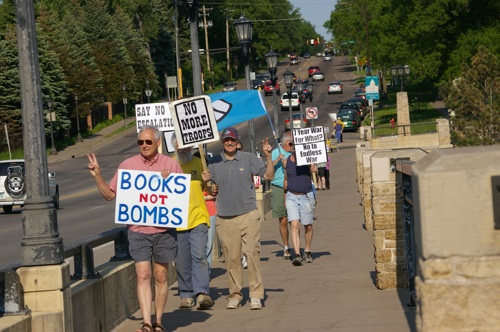
As the official war in Afghanistan flounders and as U.S. drones continue to pound targets and kill civilians in Pakistan, the weekly anti-war vigil continues on the Lake Street Bridge between Minneapolis and St. Paul.


On Wednesday afternoon, a few dozen people show up at the vigil, which has been going on since 1999. John Braun recalled that the vigil began “during the war in Yugoslavia,” and continued as a protest against the then-sanctions aimed at bringing Iraq to its knees. Now the signs call for an end to the wars in Afghanistan and Iraq.

1 Comment

Filed under Uncategorized

Heading for a Twin Cities nurses’ strike?

© Lorelyn Medina - Fotolia.com

Nurses in the metro area will vote May 19 on whether to authorize a strike when their contract expires on May 31. After months of negotiations, the nurses and healthcare executives from Twin Cities hospitals seem to have reached an impasse. Now they are taking their cases to the public. Continue reading

5 Comments

Filed under Uncategorized

Citizen journalism/El periodismo popular

In talking and teaching about citizen journalism, people frequently emphasize the contribution of the internet and “new media,” including tools such as texting, Tweeting, blogs, video, etc. Though they disagree on whether citizen journalism is the path to perdition through the destruction of standards of accuracy and ethics or the road to salvation as old journalistic structures crumble and fall, they generally agree that citizen journalism is something new. Continue reading

2 Comments

Filed under Uncategorized

X-Files and journalism

“I’m not happy with ‘we are all journalists now,'” writes Scott Rosenberg. “Let’s give it an edit. Let’s change it to ‘Now, anyone can do journalism.'”

I like Rosenberg’s change of focus. The important issue for citizen journalism is reporting, not credentialing. Continue reading

Leave a comment

Filed under Uncategorized

Who are Minnesota’s immigrants?

“Immigrants and their children represent an important component of the state’s current and future workforce, and are vital contributors to our state’s educational, cultural, and civic life,” affirms the new Minnesota Compass research project on immigration in Minnesota. The continuing research collects information from multiple sources and offers hard data to dispel myths and preconceptions about immigrants. Continue reading

Leave a comment

Filed under Uncategorized

Minnesota social service agencies trying to do more with less

Increase in client needs, United Way survey

More clients, more issues, more stress, and more “intense” issues, with less resources, lower budgets and no prospects for better days – that’s the report from a sample of 89 Minnesota social service agencies, according to a survey released today by the Greater Twin Cities United Way. Overall, 74 percent of the agencies said they saw more clients in 2009 than in 2008. In a similar survey in 2009, 63 percent of agencies reported an increased number of clients during the past year.

Who are the clients?

Agencies most commonly said they are seeing more unemployed clients (73%). More than 4 in 10 agencies indicated they are seeing more clients who are unfamiliar with the social service sector (48%), more clients without healthcare insurance (47%), more middle class clients (46%), more immigrants (44%), and more families (42%).

More intense issues mean that staff must spend more time with each client, and more clients means that the individual caseloads are increasing. At the same time, agencies are losing resources. Four out of five agencies reported losing revenue from at least one source in 2009. While some made up lost revenue with federal stimulus dollars, fully 40 percent of the agencies reported a smaller budget in 2010 than in 2009.

As the agencies are trying to meet increased client needs with decreasing resources, they are asking the same of staff. According to the report, here’s how they dealt with decreasing resources:

In 2009, agencies most frequently implemented salary freezes (53%), layoffs (40%), and hiring freezes (30%) to balance their budget. In addition, reduced staff hours (28%) or eliminated some programs or services (26%). (United Way survey, p. 8)

A December 2009 survey of 639 organizations by the Minnesota Council of Nonprofits found similar numbers, with 32 percent of organizations reporting layoffs, 52 percent reporting hiring or salary freezes, and 25 percent reducing employee benefits.

According to Elizabeth Peterson, who is in charge of research and planning at United Way, most of the agencies in the United Way survey provide services such as

food shelves, meal programs, homeless shelters, job-training programs, domestic violence shelters and services, dental services for low-income children, health screening for children (e.g., vision, hearing, asthma), community clinics, home chore services for elders, assistance for children and adults with disabilities, childcare and preschool services, home-visiting programs for parents of young children, tutoring programs to help kids read at grade level, and out-of-school-time programs.

The survey covered a wide range of agencies. Responding to an email question, Peterson said the budgets ranged from less than a million dollars annually to $52 million.

The majority (59%) have budgets between $1 million and $10 million. Nearly one-quarter (23%) have budgets over $10 million, and 18% have budgets less than $1 million.

The only bright spot in the survey is an increase in volunteers, reported by 61 percent of the agencies responding to the United Way survey. Only four percent saw fewer volunteers, with the rest remaining about the same. The Minnesota Association for Volunteer Administration also reported an increase in the number of people volunteering. There’s a downside to the increase in volunteers.

The increase seems to be primarily driven by unemployed people who became interested in volunteering; 72% of respondents indicated that is a reason inquires were up. … The change in who is volunteering was cited as both a challenge and an opportunity. The opportunity is volunteers with increased capabilities; the challenge is in designing new positions and shorter-term volunteer opportunities. One person commented, “The volunteers want less of a commitment because they are unsure how their life will be changing.” (MAVA report, p. 4)

While more volunteers can mean more help in maintaining programs and meeting the increased needs of clients, sometimes that is not enough.

Comments reflected the severity of some situations.  One person reported, “No money, no staff. No staff, no steering the ship or accountability. No accountability = confusion and dropping the ball. Volunteers leave. Program dies.”  Another person said, “I can’t keep up.  I feel like I’m neglecting people.  It makes me feel real lousy and inefficient.  This isn’t just burnout, it often feels more like just plain failure.  I’ve done this for years now and I feel I should be doing better but I can’t keep up.” (MAVA report, p. 8)

Leave a comment

Filed under Uncategorized

Minnesota homelessness increasing

Homelessness in Minnesota increased dramatically over the past three years, according to the October 2009 Wilder Research study. Wilder has conducted the study every three years since 1991, and found that homelessness stayed fairly constant from 2000-2006, with a low of 7,696 and a high of 7,854. In 2009, however, volunteers counted 9,452 homeless Minnesotans.

The 22 percent increase included 1,670 families with 3,251 children, whose average age was six and one-half years old. An additional 1,207 youth were homeless and on their own, up from 867 in 2006.

Greg Owens, the study director, characterized the results as “troubling, but not surprising.” More people are becoming homeless because of economic conditions, Wilder reported:

• 39% percent of homeless adults left their last permanent housing because of eviction, foreclosure, or failure to have their lease renewed; up from 32 percent in 2006.

• 40% of homeless adults reported a job loss or reduction in hours was a reason for the loss of their last housing; up from 31 percent in 2006

• 20% percent of homeless adults reported current employment, full or part-time, down from about 28 percent in 2006, while average hours of employment per week also dropped to 26 from 30 in 2006.

• 44% of homeless adults are on a waiting list for some form of public housing (up from 34% in 2006).

    The Wilder study was conducted by more than 1,000 volunteers who interviewed people across Minnesota in shelters, transitional housing programs, drop-in service locations and other locations such as abandoned buildings or places where homeless people camp. Wilder survey included only those people who were actually located and interviewed. Later reports will include estimates of the number of people who were missed.

    Looking just at Hennepin and Ramsey counties, the Minnesota Housing Partnership’s “2 x 4” report for the fourth quarter of 2009, released March 31, found mixed figures on homelessness in December:

    • For the 4th quarter, an average of 260 families per month occupied Hennepin County contracted shelters. This number is 12% higher than the 4th quarter of 2008, and 66% higher than the 4th quarter of 2006.

    • However, there was a dramatic fall in family homelessness within the quarter itself in Hennepin County. In December, the family homeless number eased markedly to 201 families, likely due to the homeless prevention program discussed above.

    • The Minneapolis and St. Paul public schools identified 4,700 homeless youth through December of the school year, 8% higher than last year and 22% higher than the year before.

    Leave a comment

    Filed under news, Uncategorized

    Once more, with feeling – marching on Washington for immigration reform

    (courtesy of Rini Templeton)

    I wish I could be in Washington today, with the immigrant March for America – just as I wished I could be there in 1963, for the first grand March on Washington in my lifetime. The 1963 march was Dr. Martin Luther King’s march, with 250,000 people from all over the country spilling out from the Lincoln Memorial down the Mall. Organizers called it the “March for Jobs and Freedom,” a name now almost buried in the history books. The 1963 march had been preceded by a smaller, 25,000-person march in 1958, called the Prayer Pilgrimage for Freedom.

    Today’s march is called the “March for America,” a march by immigrants and allies asking for change in the broken immigration system. Many Minnesotans are among the marchers, including the busloads of people who set out from El Colegio about 6 a.m. on Saturday. Among the specific changes advocated by the marchers:

    • improving the economic situation of all workers in the United States;
    • legalizing the status of undocumented immigrants working and living in the United States;
    • reforming visa programs to keep families together, protecting workers’ rights, and ensuring that future immigration is regulated and controlled rather than illegal and chaotic;
    • implementing smart, effective enforcement measures targeted at the worst violators of immigration and labor laws;
    • prioritizing immigrant integration into our communities and country; and
    • respecting the due process rights of all in the United States.

    Marching on Washington is a long U.S. tradition. Washington is the seat of political power, the place to go for redress of grievances or for help in times of trouble.

    Coxey’s Army marched on Washington in 1894, an army of unemployed workers seeking help during a severe four-year depression that began with the bank failures and Panic of 1893. Populist Jacob Coxey organized a second march in 1914, and, in 1932, Father James Renshaw Cox organized 25,000 unemployed workers to march, demanding a public works program, during the Great Depression.

    During the same year, 20,000 World War I vets and family members organized as the Bonus Army, and marched on Washington demanding that the Hoover administration give them early payment of the bonuses they had earned. Police opened fire, killing some of the marchers, and President Hoover ordered the army to drive the rest from the city at bayonet-point.

    Women marched on Washington in 1913, demanding the right to vote

    In 1925, the Ku Klux Klan marched on Washington, 35,000 strong.

    In 1943, rabbis marched, demanding action to stop Hitler’s genocidal destruction of Europe’s Jews.

    Marchers opposed the Vietnam war in April and November of 1965, and in the larger 1967 March on the Pentagon, as well as the 1968 Jeanette Rankin brigade march, and the 200,000-person Moratorium to End the War in Vietnam on October 15, 1969, followed by the 600,000-person National Mobilization Committee to End the War in Vietnam Moratorium one month later.

    Since then, marches have become much more frequent, with causes that vary widely – from anti-war and anti-racism protests to Tractorcade (1979-opposing U.S. farm policy) to the Million Man March (1995-to “convey to the world a vastly different picture of the Black male”) to ProjectMARCH (2006-for colon cancer screening) to the Over 9000 Anonymous March (2008-protesting the Church of Scientology.)

    Last year saw three Tea Party events, of varying sizes. Yesterday (March 20) protesters marched against the wars in Iraq and Afghanistan.

    And today, as health care reform goes to a vote in the House of Representatives, immigrants and allies are marching for their turn, marching for reform, marching for what may be an even tougher fight than health care.

    President Obama has pledged his support – repeatedly. Representative Luis Gutierrez (D-IL) is the point person on immigration reform. He introduced a bill in December, which is the starting point for work on immigration reform. The acronym for his bill, HR 4321, is CIR ASAP, which stands for both the Comprehensive Immigration Reform Act for America’s Security and Prosperity and Comprehensive Immigration Reform As  Soon As Possible. In his press release about the introduction of the bill, Gutierrez said:

    We have given.  And we have waited.  And we have compromised.  But there are some fundamentals that simply cannot be negotiated away and cannot be waited for one minute longer:

    The ability of a mother to stay with her son.  For an honest person to work hard.  For all families in our country to be safe.

    Our families.  Our jobs.  Our security.

    Three simple principles.  Three American principles.  Not just for immigrants, but for all of us.   Every American will benefit from this bill, from the heightened national security, from the commitment to family unity, from the common-sense approach to jobs and our economy.

    Families. Jobs. Security. Today’s March for America is one more step on that road.

    Leave a comment

    Filed under Uncategorized