Author Archives: Mary Turck

Mary Turck's avatar

About Mary Turck

News Day, written by Mary Turck, analyzes, summarizes, links to, and comments on reports from news media around the world, with particular attention to immigration, education, and journalism. Fragments, also written by Mary Turck, has fiction, poetry and some creative non-fiction. Mary Turck edited TC Daily Planet, www.tcdailyplanet.net, from 2007-2014, and edited the award-winning Connection to the Americas and AMERICAS.ORG, in its pre-2008 version. She is also a recovering attorney and the author of many books for young people (and a few for adults), mostly focusing on historical and social issues.

A dancing cop and the theater of history

See the video on Aaliyah Taylor's Facdbook page - https://www.facebook.com/aaliyahlovingya/videos/792864037490488

See the video on Aaliyah Taylor’s Facdbook page – https://www.facebook.com/aaliyahlovingya/videos/792864037490488

Besides the horrific video of a police officer throwing a 16-year-old girl across the school room, October’s news included the dancing D.C. cop who defused a potentially nasty situation. Continue reading

Leave a comment

Filed under race

Marauding turkeys in the news, along with turtles, camels and reindeer

St. Paul turkey on St. Anthony Avenue

St. Paul turkey on St. Anthony Avenue

This week’s news is going to the dogs — and the turkeys, turtles, camels, reindeer, donkeys and sheep. Continue reading

Leave a comment

Filed under Uncategorized

The not-so-hidden racism of school discipline in Minneapolis and St. Paul

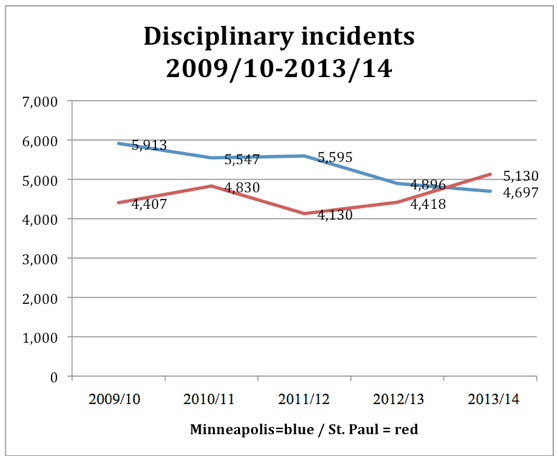
Total number of disciplinary incidents, including suspensions and expulsions, reported by Minneapolis and St. Paul school districts over the past five years

Total number of disciplinary incidents, including suspensions and expulsions, reported by Minneapolis and St. Paul school districts over the past five years

Last week’s news included the horrific video of a police officer throwing a 16-year-old girl across the school room — apparently because she only put away her cell phone, but refused to give it to her teacher. Bad as it is, the video shows only the tip of the iceberg of racially disparate school discipline, which persists across the country and here in the Twin Cities as well.

Vox compiled a series of seven charts showing racism in school discipline, using national statistics. I wondered how Minneapolis and St. Paul would compare, so I went to the Minnesota Department of Education website to find the numbers.

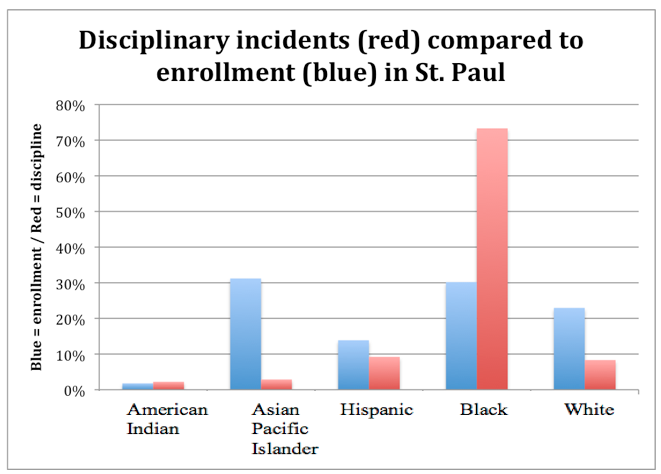
Vox reports that black students are suspended or expelled at higher rates throughout their school years, across the nation. That’s also true in Minneapolis and St. Paul. African American students are disciplined at a far higher rate than any other race or ethnicity reported. Here are the breakdowns for Minneapolis and St. Paul:

Mpls discipline disparities

St. Paul discipline disparities

The Minnesota Department of Education figures show the total number of “disciplinary incidents” by race and ethnicity. These include suspensions, expulsions and other reported incidents.

In Minneapolis, black students make up 37 percent of the student population, but 75 percent of the disciplinary incidents. In St. Paul, black students make up 30 percent of the student population, but 73 percent of the disciplinary incidents. In Minneapolis, Native American students make up 4 percent of the student population, and 8 percent of the disciplinary incidents.

The U.S. Department of Education Office for Civil Rights reported last year on racial and other disparities in school discipline. They found disproportionately high suspension/expulsion rates for students of color, disproportionate discipline for girls of color, disproportionate suspension of students with disabilities, and disproportionate arrests and referrals to law enforcement by race and disability status.

Racial disparities in discipline begin early and continue throughout school years. The disparities are not explained by differences in behavior. Vox explains:

“A common reaction to the discipline disparities is to suggest that something other than race is at work — that they’re a function of poverty, or that black students are simply more likely to misbehave. But analyses of the data have found that isn’t true. Black students and white students are sent to the principal’s office at similar rates; states report they commit more serious offenses, such as carrying weapons or drugs at school, at similar rates; and when surveyed about their own behavior, they report similar patterns. Even in cases in which black students do disproportionately act out — a 2008 analysis found twice as many black boys as white boys reported bringing a gun to school — they’re more likely to be punished than white students who committed the same infraction.”

Part of the problem is in the presence of police in the schools as School Resource Officers. Writing in the Hechinger Report, Beth Hawkins said that “even controlling for socioeconomic status, students at schools where there is an SRO are at least five times more likely than their peers to be arrested and sent into the juvenile justice system by the officers.”

Overuse of punishment to respond to discipline problems also may be correlated to the lack of counseling resources. Minnesota has one counselor for every 792 students, the third-worst ratio in the entire country.

Failure to educate students also contributes to racial disparities in discipline. Dropout Nation blogger Rishawn Biddle, writing about Minneapolis racial disparities in discipline last year, identified both a cause and a solution:

“[The] district is dealing miserably with the underlying illiteracy that is the key culprit for student misbehavior. …  This means intensive reading remediation, especially in the early grades when discipline issues can be headed off … Systemic reform, in short, is key to reducing overuse of suspensions for the long haul.”

In a press release from ISAIAH last year, Professor Nekima Levy-Pounds said the statistics on racially disparate suspensions “should break our hearts, and compel us all – especially the faith community – to act in a transformative way.” It’s time, and long past time, to act.

x x x

Want to learn more?

2 Comments

Filed under education, race

Change must come to St. Paul schools

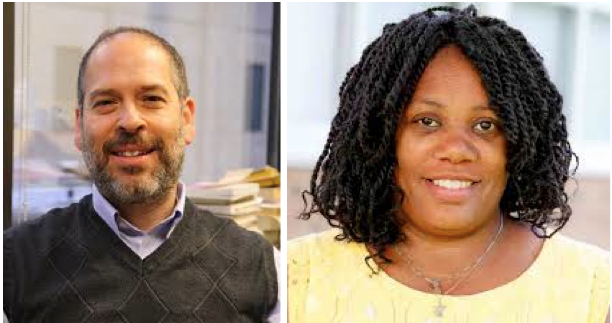
Steve Marchese and Zuki Ellis are two of the Caucus for Change candidates for St. Paul's school board.

Steve Marchese and Zuki Ellis are two of the Caucus for Change candidates for St. Paul’s school board.

St. Paul Public Schools (SPPS) will have at least three and possibly four new members after the November 2 election. So who are you voting for? And will that make a change?  Continue reading

2 Comments

Filed under education, St. Paul Notes

Deporting to death: U.S. and refugees

Syrian refugees drown, washing up on beaches in public view. Central American refugees, deported back to the countries they fled, die out of sight, out of mind. The Guardian highlighted three cases of young Honduran men who were murdered shortly after being deported. They are three among many, says The Guardian, referring to a study by a San Diego State University social scientist who has identified 83 such cases in El Salvador, Honduras, and Guatemala since January 2014. Continue reading

5 Comments

Filed under human rights, immigration

Celebrate Indigenous Peoples Day in Minneapolis and St. Paul

Photo of 2012 Indigenous Peoples Day celebration in Berkeley by Quinn Dombrowski, published under Creative Commons license.

Photo of 2012 Indigenous Peoples Day celebration in Berkeley by Quinn Dombrowski, published under Creative Commons license.

Yes — October 12 is Indigenous Peoples Day in the Twin Cities! Celebrating means recognizing the legacy and continuing contributions of Native Americans to this country and state. As Congressmember Keith Ellison said last year, during the Minneapolis debate:

“The very foundation of the United States, the theoretical concept of it, offered to our nation by the Iroquois Confederacy, as we were told growing up, ‘Oh, this is from the Greeks.’ We weren’t told about the Iroquois Confederacy, but we learned about it. And now that we have established Indigenous Peoples Day, every child – whether that child is Native, or whether that child is not – will learn the truth about where America really, really comes from.”

Continue reading

Leave a comment

Filed under human rights

Half-staff: Oregon to Afghanistan

[UPDATED 10/6] I saw the flag flying at half-staff today, and wondered — could it be because of the 19 22 medical personnel and patients killed by a U.S. bombing raid that repeatedly hit a hospital in Afghanistan on Saturday? No, of course not. The United States would never fly a flag at half staff for a mistake made by our own military, no matter how many doctors and nurses and children were killed. The flag is flying at half-staff because of another tragedy, the shootings that killed nine people at Umpqua Community College in Oregon. Two tragedies, one perpetrated by an individual acting against all laws and morality and the other, an official act done by our government in our name.

Continue reading

Leave a comment

Filed under Uncategorized

Dear NRA Member: Please resign

I grew up on a farm, with rifles and shotguns leaning on the back wall of our home’s entryway, boxes of shells on the windowsill. My grandpa, dad, uncles and brothers all hunted. Many of my relatives still hunt, but guns no longer sit casually, unlocked and unguarded. Just as hunters in our family have changed the way their guns are stored, so the country needs to change our gun laws. In order to do so, every responsible gun owner needs to withdraw their support from the NRA, which has repeatedly obstructed all efforts to regulate or even to study regulation of guns in this country.

Continue reading

Leave a comment

Filed under Uncategorized

Migrants and memes

May 1, 2006 - Minneapolis

May 1, 2006 – Minneapolis

While the Syrian refugee crisis holds world attention, immigration changes within the United States continue to come slowly, if at all. In this month’s news: Continue reading

Leave a comment

Filed under immigration

Syrian suffering, refugees continue: U.S. response is small and slow

Syrian refugees' camp in Cappadocia, Turkey. Photo by Fabio Sola Penna, published under Creative Commons license. 

Syrian refugees’ camp in Cappadocia, Turkey. Photo by Fabio Sola Penna, published under Creative Commons license.

In an eloquent cri de coeur, Lina Sergie Attar wrote about the agony of Syria:

“Now, the everyday violence and death Syrians witness is no longer recorded in full force unless events surpass the daily ‘acceptable’ quota of death—like it did on August 16 in Douma, after more than 100 people were killed by a regime aerial attack on a crowded marketplace. These kinds of mass tragedies, like the chemical weapons attack in 2013 and the Daraya massacre in 2012, capture the world’s attention—headlines, outrage, condemnation—for a few moments before Syria’s suffering once again fades to white noise. When the country has been reduced to smoldering ashes and its people have been forced into a mass exodus to new countries and new homes, our capacity to document—to speak or write and chant—dwindles. History collapses into a simple etcetera.”

More than four million refugees have fled Syria. Millions more remain inside Syria, but no longer in their own homes, internal refugees forced to flee for their lives. Continue reading

Leave a comment

Filed under human rights, immigration