Category Archives: race

A dancing cop and the theater of history

See the video on Aaliyah Taylor's Facdbook page - https://www.facebook.com/aaliyahlovingya/videos/792864037490488

See the video on Aaliyah Taylor’s Facdbook page – https://www.facebook.com/aaliyahlovingya/videos/792864037490488

Besides the horrific video of a police officer throwing a 16-year-old girl across the school room, October’s news included the dancing D.C. cop who defused a potentially nasty situation. Continue reading

Leave a comment

Filed under race

The not-so-hidden racism of school discipline in Minneapolis and St. Paul

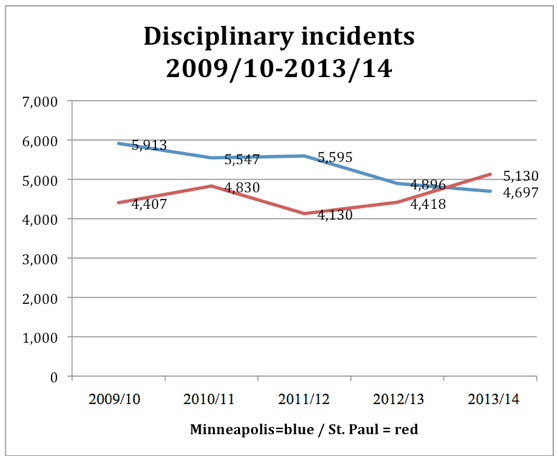
Total number of disciplinary incidents, including suspensions and expulsions, reported by Minneapolis and St. Paul school districts over the past five years

Total number of disciplinary incidents, including suspensions and expulsions, reported by Minneapolis and St. Paul school districts over the past five years

Last week’s news included the horrific video of a police officer throwing a 16-year-old girl across the school room — apparently because she only put away her cell phone, but refused to give it to her teacher. Bad as it is, the video shows only the tip of the iceberg of racially disparate school discipline, which persists across the country and here in the Twin Cities as well.

Vox compiled a series of seven charts showing racism in school discipline, using national statistics. I wondered how Minneapolis and St. Paul would compare, so I went to the Minnesota Department of Education website to find the numbers.

Vox reports that black students are suspended or expelled at higher rates throughout their school years, across the nation. That’s also true in Minneapolis and St. Paul. African American students are disciplined at a far higher rate than any other race or ethnicity reported. Here are the breakdowns for Minneapolis and St. Paul:

Mpls discipline disparities

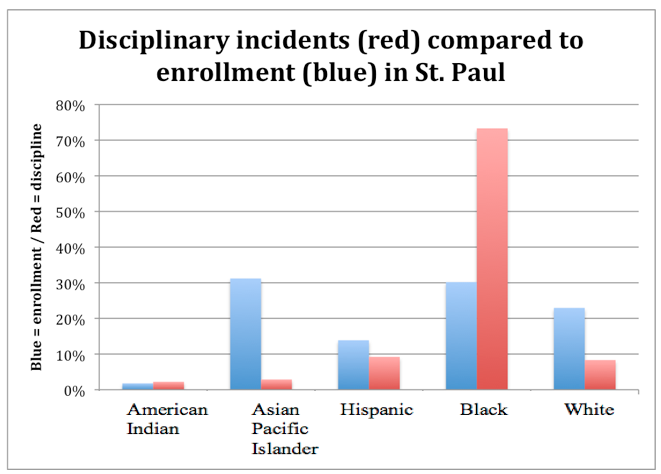
St. Paul discipline disparities

The Minnesota Department of Education figures show the total number of “disciplinary incidents” by race and ethnicity. These include suspensions, expulsions and other reported incidents.

In Minneapolis, black students make up 37 percent of the student population, but 75 percent of the disciplinary incidents. In St. Paul, black students make up 30 percent of the student population, but 73 percent of the disciplinary incidents. In Minneapolis, Native American students make up 4 percent of the student population, and 8 percent of the disciplinary incidents.

The U.S. Department of Education Office for Civil Rights reported last year on racial and other disparities in school discipline. They found disproportionately high suspension/expulsion rates for students of color, disproportionate discipline for girls of color, disproportionate suspension of students with disabilities, and disproportionate arrests and referrals to law enforcement by race and disability status.

Racial disparities in discipline begin early and continue throughout school years. The disparities are not explained by differences in behavior. Vox explains:

“A common reaction to the discipline disparities is to suggest that something other than race is at work — that they’re a function of poverty, or that black students are simply more likely to misbehave. But analyses of the data have found that isn’t true. Black students and white students are sent to the principal’s office at similar rates; states report they commit more serious offenses, such as carrying weapons or drugs at school, at similar rates; and when surveyed about their own behavior, they report similar patterns. Even in cases in which black students do disproportionately act out — a 2008 analysis found twice as many black boys as white boys reported bringing a gun to school — they’re more likely to be punished than white students who committed the same infraction.”

Part of the problem is in the presence of police in the schools as School Resource Officers. Writing in the Hechinger Report, Beth Hawkins said that “even controlling for socioeconomic status, students at schools where there is an SRO are at least five times more likely than their peers to be arrested and sent into the juvenile justice system by the officers.”

Overuse of punishment to respond to discipline problems also may be correlated to the lack of counseling resources. Minnesota has one counselor for every 792 students, the third-worst ratio in the entire country.

Failure to educate students also contributes to racial disparities in discipline. Dropout Nation blogger Rishawn Biddle, writing about Minneapolis racial disparities in discipline last year, identified both a cause and a solution:

“[The] district is dealing miserably with the underlying illiteracy that is the key culprit for student misbehavior. …  This means intensive reading remediation, especially in the early grades when discipline issues can be headed off … Systemic reform, in short, is key to reducing overuse of suspensions for the long haul.”

In a press release from ISAIAH last year, Professor Nekima Levy-Pounds said the statistics on racially disparate suspensions “should break our hearts, and compel us all – especially the faith community – to act in a transformative way.” It’s time, and long past time, to act.

x x x

Want to learn more?

2 Comments

Filed under education, race

Reading Horizons “proves” that Reading Horizons works (and I have a bridge in Brooklyn to sell you)

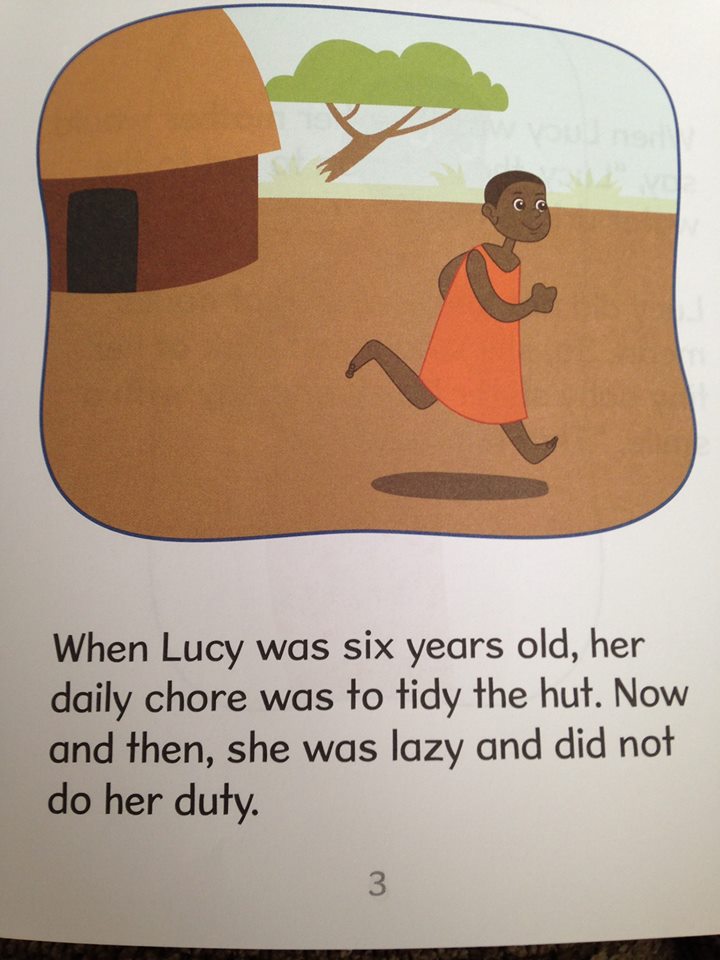
Page from one of the now-withdrawn Reading Horizons

Page from one of the now-withdrawn Reading Horizons “Little Books”

The million dollar boondoggle that is Minneapolis Public Schools contract with Utah-based Reading Horizons continues. Now MPS wants Reading Horizons to rewrite its offensive and racist “Little Books.” MPS insists that “research shows this program has been successful in improving student outcomes around the country, including outcomes in diverse districts like ours.” Where is the research that MPS relied on? Does it exist? And if it doesn’t, what is explanation for a $1.2 million contract? Continue reading

3 Comments

Filed under education, race

Why you should read Sarah Lahm on Reading Horizons

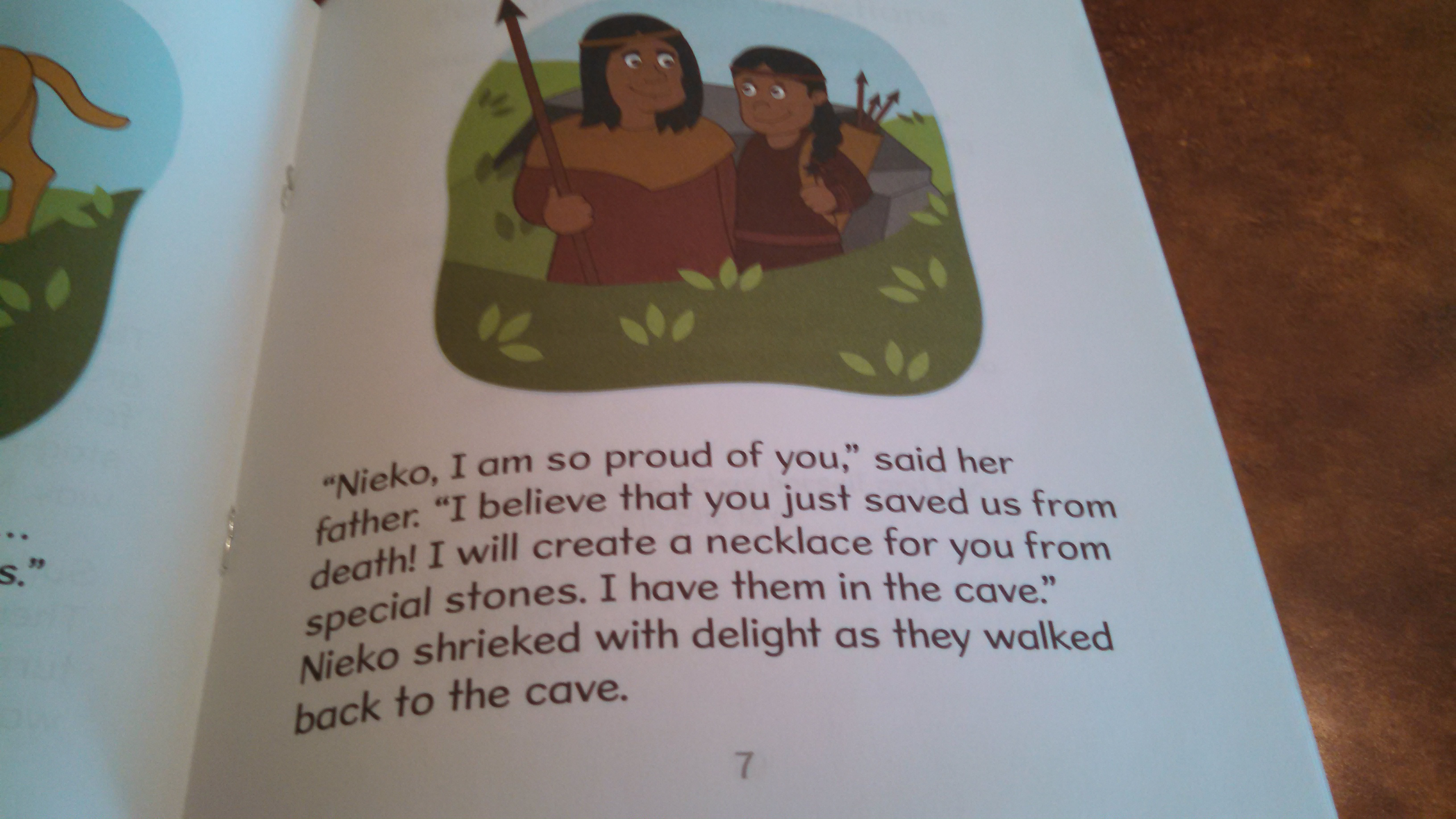
Page from one of the now-withdrawn Reading Horizons  "Little Books" -

Page from one of the now-withdrawn Reading Horizons “Little Books” –

Sarah Lahm started telling the story in August: A corporate contractor got more than a million dollars from Minneapolis Public Schools and delivered offensive teacher training and racist books. Nine or ten blog posts later, the story continues to grow and now the Washington Post has picked it up, crediting Lahm for her investigative reporting, which uncovered the scandal. Continue reading

2 Comments

Filed under education, race

Need a little hope? Read on!

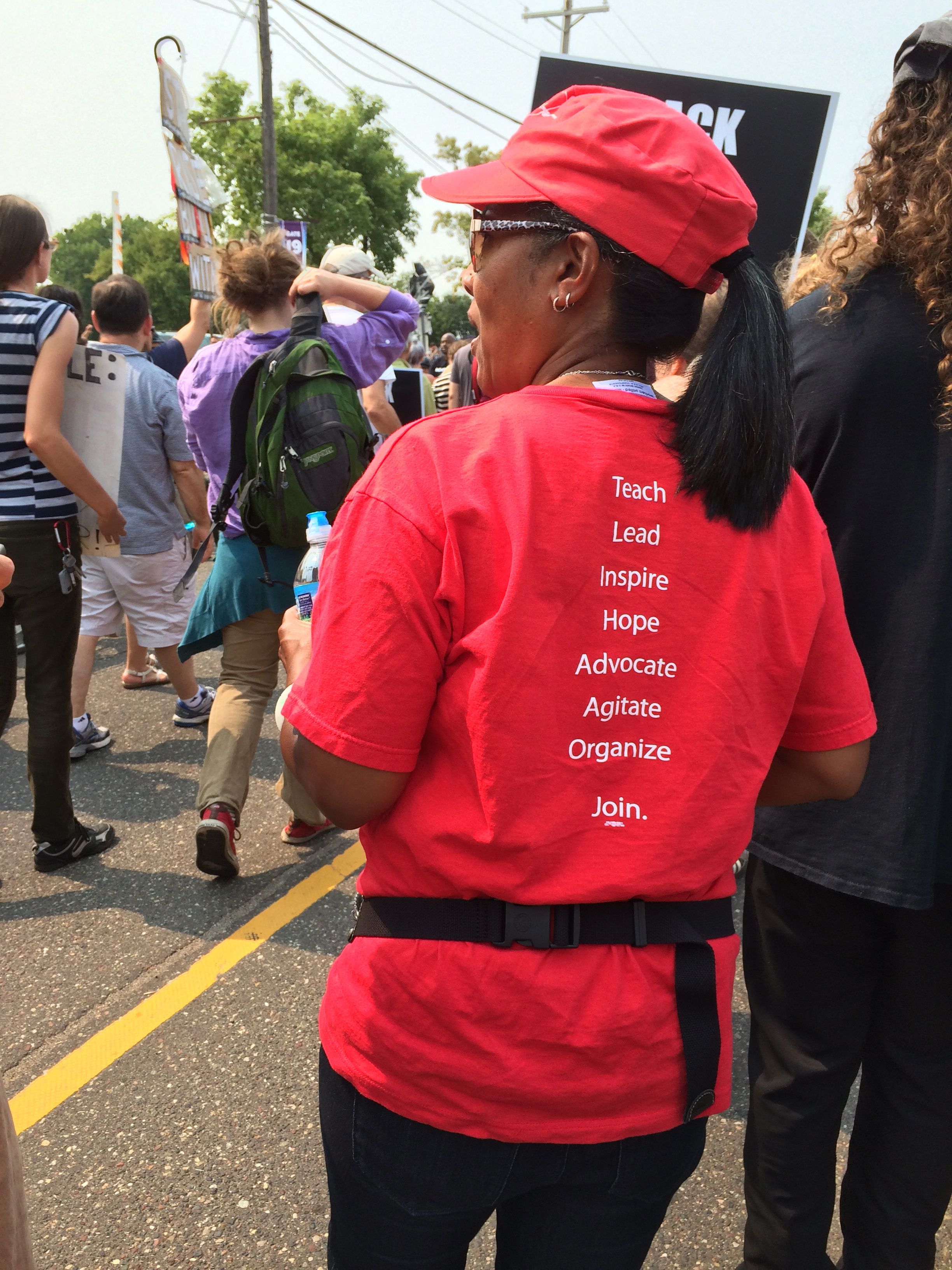
Teacher with shirtHad enough of this week’s death and horror? Here are six stories of hope and action, from Austria to California to Minnesota. Sometimes I need to focus on these stories to continue believing that each of us can make a difference. If you need that lift, too, read on. Continue reading

Leave a comment

Filed under immigration, media, race

Black Lives Matter goes to the Minnesota State Fair

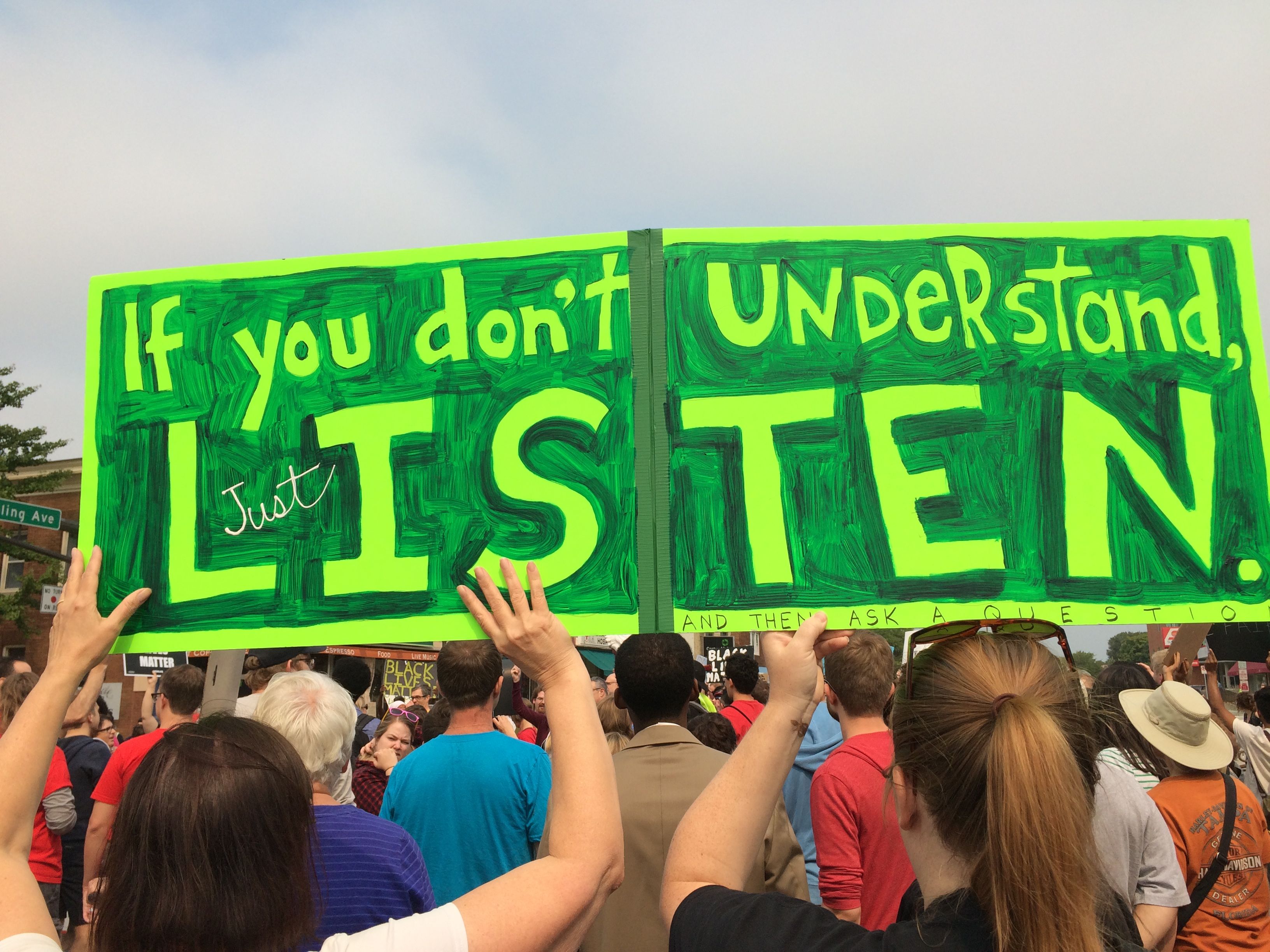
ListenFor all my friends who want to know what it was like, and why it was important …

The day started like a picnic at Hamline Park, with people saying hello to old friends, kids running around, and people painting last-minute protest signs. Okay, maybe family picnics don’t usually have protest signs, but the family feeling was definitely there. Old people, young people, black people, white people, Asian and Native American people, queer people, straight people, trans people, lots of Unitarians and seminarians in clerical collars, babies in strollers and people in wheelchairs. Continue reading

3 Comments

Filed under race

#BlackFair and the Minnesota State Fair

As usual, many of this year's  crop art entries reflect political issues.

As usual, many of this year’s crop art entries reflect political issues.

I love the Minnesota State Fair. But dang it all — Black Lives Matter is right about structural/institutional racism at the Fair and in the state. So I went to the fair today, and I also plan to go to the #BlackFair march on Saturday. I agree with Julie Blaha, who wrote in a letter to the editor to the Strib:

“I love the State Fair with a passion that borders on obsession … [but] I have no problem with disruption for a good cause.

“If I’m willing to wait half an hour for deep-fried pickles, I can spend a little time on something as important as ending racism. Fairgoers, the least we can do for our neighbors suffering injustice is to put down the mini doughnuts for a bit and listen.”

Continue reading

4 Comments

Filed under race

Read a story, say a prayer, write a check: Remember Michael Brown

IMG_3837Just for today, take one small step to remember Michael Brown’s death in Ferguson, one year ago today. Read one story (doesn’t have to be this one), say one prayer, send one check to an organization working for racial justice, talk to one family member or friend about race. Just for today, take one step, and then tomorrow, take another. One step after another, getting on the road.

Today, dozens of news reports say that Michael Brown’s family is still mourning his death, one year later. Well, yeah. Lots of families still mourn: Eric Garner. Tamir Rice. Samuel Dubose. Freddie Gray. Sandra Bland. Walter Scott. Eric Harris. The list goes on and on.

Last year, when Michael Brown was shot by a police officer, we didn’t know how many people were shot and killed by police in the U.S. every year. No government agency counted these deaths. A British newspaper stepped up. The Guardian’s The Counted project documents people killed by police in the United States. So far this year: 700. At the beginning of June, the Guardian reported:

“The Guardian’s statistics include deaths after the police use of a Taser, deaths caused by police vehicles and deaths following altercations in police custody, as well as those killed when officers open fire. They reveal that 29% of those killed by police, or 135 people, were black. Sixty-seven, or 14%, were Hispanic/Latino, and 234, or 50%, were white. In total, 102 people who died during encounters with law enforcement in 2015 were unarmed.

“The figures illustrate how disproportionately black Americans, who make up just 13% of the country’s total population according to census data, are killed by police. Of the 464 people counted by the Guardian, an overwhelming majority – 95% – were male, with just 5% female.”

Race matters. Race matters in life as well as in death. Ta-Nehisi Coates explained in “Letter to My Son” that: “Here is what I would like for you to know: In America, it is traditional to destroy the black body— it is heritage.” He asked readers to respond with their own stories of racism. They did, by the hundreds, their responses published in three separate Atlantic articles. One of the stories in the first article comes from a 35-year-old Florida reader, who begins:

“Crazy. Today is Sunday, July 5th. About two hours ago, I saw a tweet from Bomani Jones about Ta-Nehisi’s piece “Letter to My Son” and read it of course. It was a break from some work I was completing. I saw the request for personal stories about “The Talk.” (One of the commandments my mother gave me: When I get pulled over, pull over in a populated area so there will be witnesses.) I thought I would email a story later this week. I resumed my work but realized I needed a book I had left at the office. It’s about 20 minutes from my house, so I hopped in the car.”

He details the police following him, his stop at a gas station, what they say and do, and what he thinks, on a Sunday afternoon, near his home, before he is finally released to go get his book and resume his life:

“We walk up to my car so I can get my ID. I am fuming. I get my wallet and slam my door. ‘Calm down, I could be worse,’ says the other officer. I say, ‘I’m stopped here. Gun drawn on me. You’re right. I could be shot.’ He responds, ‘You don’t understand.’ I bite my tongue before I go off. I don’t understand? It’s a Sunday afternoon and here I am standing in a gas station parking lot, with my hands on my head, after having a gun pulled on me and patted down by an officer, all while another officer circled my vehicle with his hand on his weapon. He had a point; I guess the threat of being shot is better than being shot.”

Read the stories — Part I, Part II, and Part III. Today most white Americans say they are satisfied with the way that black Americans are treated. Not surprisingly, most black Americans disagree. One encouraging sign — the percentage of white Americans who are satisfied has dropped from 67 percent in 2013 to 53 percent in 2015. We can learn.

We must learn. And we must act. The problem with racism in this country goes far beyond policing. Racism shapes housing and segregation. Racism deforms education. Denial perpetuates its reign.

So step one: Read one story. Say a prayer. Send a check, Talk to someone. Take one step today. And another tomorrow.

Leave a comment

Filed under human rights, race