About Mary Turck
News Day, written by Mary Turck, analyzes, summarizes, links to, and comments on reports from news media around the world, with particular attention to immigration, education, and journalism. Fragments, also written by Mary Turck, has fiction, poetry and some creative non-fiction.
Mary Turck edited TC Daily Planet, www.tcdailyplanet.net, from 2007-2014, and edited the award-winning Connection to the Americas and AMERICAS.ORG, in its pre-2008 version. She is also a recovering attorney and the author of many books for young people (and a few for adults), mostly focusing on historical and social issues.
April 26, 2016 · 9:44 pm

In Lake Wobegon, all the children are above average, and that’s pretty much the Minnesota motto for everything. We have above average biking cities, above average hipster neighborhoods, and above average funding for public education. Oops — scratch education off the list. NPR’s School Money series just popped that civic pride balloon. Continue reading →
April 26, 2016 · 10:44 am
The Hechinger Report’s three-part series on teacher education programs offers fascinating glimpses inside three classrooms, alongside appalling pictures of first-year teachers’ home lives. Meghan Sanchez has abandoned her teacher training program’s emphasis on ” 100 percent compliance with directions 100 percent of the time” as unrealistic for wiggly 4-year-olds who can’t always sit “criss-cross-applesauce” on command. Michael Duklewski has switched from correcting his middle-schoolers’ negative behavior to pointing out positive behavior, and finds that “I’m just happier, because I’m saying good things all the time instead of harping on bad things.” Amit Reddy engages his eighth-grade science students in pouring liquids into a beaker to determine their density, but worries about the lagging grades of his “chatty” after-lunch class section. And all three of the featured first-year teachers get up before 6 a.m. and collapse into bed at night after working 12-15 hour days. They have little or no time for family life of their own.
Continue reading →
April 22, 2016 · 2:04 pm
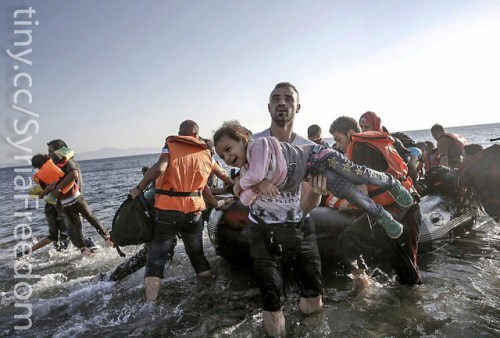
A Syrian migrant holds a young girl in his arms upon arriving on a dinghy to the Greek island of Kos, Greece.(EPA/Yannis Kolesidis) (Photo courtesy of Freedom House.
One year ago, I wrote “At least seven hundred people, maybe 900 or more, were on the 70-foot ship that sank in the Mediterranean on Sunday. Almost all of them died.” Last week, it happened again. Another boat packed with refugees capsized and sank, drowning hundreds of refugees. Continue reading →
April 12, 2016 · 8:33 pm
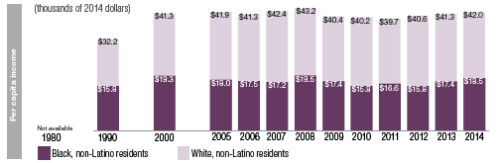
Diving Deeper: Understanding Disparities between Black and White Residents in the Twin Cities Region (Met Council), p. 7
A new report from the Met Council takes a deep dive into statistics, juggling 10 different demographic factors (e.g. age, education, immigration) to isolate one variable: race. The report finds that “underlying demographic differences cannot explain away our region’s disparities in employment, income, and homeownership between Black and White residents.” One factor can explain the differences: continuing institutional and structural racism, which is maintained and supported by conscious and unconscious personal racism. Continue reading →
April 12, 2016 · 12:04 pm
I remember meeting Bertha Oliva in Tegucigalpa in the late 1980s, the wall outside her small office tagged with graffiti death threats, gunshots in the night bringing an unnatural stillness to the city center, silencing even the dogs and roosters. Decades of human rights defense later, Bertha Oliva told Congress last week that death squads are back in Honduras. Death squads, like the one that kidnapped her husband back in the 1980s. Death squads, like the ones that threatened her and the Committee for the Relatives of the Disappeared throughout the 1980s and into the 1990s. Continue reading →
April 8, 2016 · 11:31 am
Hennepin County Attorney Mike Freeman delivered the official story on March 30, along with piles of documents and videos available on his website. According to the official story, a complete investigation resulted in no charges because it’s tough to charge a police officer with anything and there just wasn’t enough evidence. Several people have poked giant holes in Freeman’s presentation, including his misstatements of evidence, his dismissing the importance of eyewitness testimony, his over-statement of the reliability and meaning of forensic evidence, and his use of language and rhetoric that dehumanized and denigrated Jamar Clark. Continue reading →
March 25, 2016 · 11:08 am
The United States signed the Trans-Pacific Partnership (TPP) trade agreement in February, but there’s still time to stop the deal that some are calling “NAFTA on steroids” before it becomes law. Signing is only one step: the next step is passage by Congress. In this election year, you can contact your U.S. Senators and Representatives to say a resounding NO to TPP. Here are four reasons to stop TPP, and links to contact information for Congress. Continue reading →
Filed under agriculture, environment, food and farming, work
Tagged as agriculture, environment, fast track, free trade, international trade, TPP, trade deal, trade policy, Trans Pacific Partnership, workers' rights
March 24, 2016 · 10:58 am
 The Minnesota Spokesman-Recorder asked me to report on the situation in Glendale Townhomes, the oldest public housing in Minnesota. That article — Mpls Public Housing residents fight redevelopment plan — is now published. In it, I present facts and opinions of the people directly involved in the process. I also have blogged extensively about the current dispute between Glendale residents and the Minneapolis Public Housing Authority, and have been generally critical of the redevelopment option that MPHA initially proposed almost a year ago. You can find the blog posts here. Continue reading →
March 22, 2016 · 8:32 pm
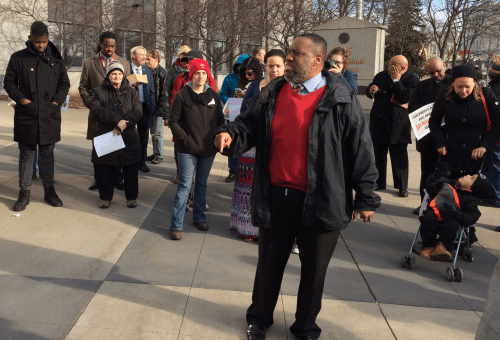
Reverend Ovester Armstrong, Jr. speaks to #StopCCA rally
“They are not building these prisons to stay empty,” Reverend Ovester Armstrong, Jr. told protesters at the Minnesota State Office Building on March 22. “They are building these prisons to fill them up.” Inside, the House Public Safety Committee held hearings on re-opening a private prison in Appleton. The private prison is owned by the Correctional Corporation of America (CCA), the largest prison company in the United States.
“We should help people, not make money off of them,” said Reverend Armstrong. “We should not let someone’s life be held hostage to a dollar bill.” Continue reading →
March 19, 2016 · 3:00 pm
 What’s wrong with GMOs (genetically modified organisms) in food production? While many GMO critics say they pose health hazards, I find that argument unconvincing. Instead, I am concerned about:
- the tie between GMO crops and overuse of pesticides and fertilizer, each of which has serious environmental consequences;
- the contribution of seed companies and GMOs to the increasing industrialization of agriculture, which I believe harms the land, farmers and consumers;
- GMO genetic drift, which contributes to contamination of crops of neighboring farmers and, even more seriously, may contribute to the development of superweeds.
I support GMO labeling for the same reason that I support other labeling, such as country of origin labeling for meat and vegetables or rBGH labeling for dairy products. I think more information is a positive good, and that consumers should be allowed to make their own choices. For example, while I see no human health hazards in drinking milk produced by cows treated with rBGH, I see very high health hazards to the cows — and a detriment to dairy farming in general. For those reasons, I choose not to buy dairy products unless they are rBGH-free, and I support labeling because it gives me an option to choose. Continue reading →






 Mary Turck