
Tag Archives: media

NEWS DAY | Tornado touchdown in Minneapolis / UCB up / All the children are above average / Whole Foods, meet Jess Durant and Will Allen

Tornado touchdown in Minneapolis “I heard a loud noise, it got louder and louder, I heard the roof coming up, it was the most weirdest sound I ever heard in my life. My heart was beating so fast, I realized it was a tornado, I dived as fast as I could into my bathtub,” Shane Gillespie told MPR, after Wednesday afternoon’s brief tornado touchdowns in south Minneapolis and downtown. The tornadoes triggered sirens (but not until after the touchdowns), emergency plan activation (“We are locking the doors to the store now. Everyone go to the dress section – that’s the safe zone.”), a mayoral press conference, and frenzied media coverage.

Unemployment claims up-again For a second week, the U.S. Department of Labor reported, “unexpected” increases in unemployment claims, with seasonally adjusted initial claims rising to 576,000 from last week’s 561,000. These are new claims: the total number of workers receiving unemployment benefits and emergency extended benefits is 9.18 million, according to the Star Tribune. Millions more do not qualify for unemployment benefits, or remain out of work even after exhausting the extended benefit period.

Where all the children are above average Or at least our Minnesota children are above average on the ACT tests. Or at least above average (best performance in the nation!) on the ACT tests taken by students in states where more than half the students take ACT tests. Our kids score 1.3 percent higher than second-place Iowa students and 1.8 percent higher than third-place Wisconsin students and a whopping 2.7 percent higher than the national average.

So what does it all mean? Perhaps that the ACT PR folks know how to time news releases for maximum ink and column inches in a slow news month. They got a nice headline in the PiPress, Minnesota retains top spot in ACT scores; Wisconsin ranks third, a more skeptical and nuanced read from Bob Collins at MPR, and a lengthier analysis at the Star Tribune, which pointed out that overall numbers of ACT test-takers are up this year because Illinois, Colorado, Michigan, Kentucky and Wyoming require 100% of their grads to take the test.

The ACT has pages and pages of data that can be sliced and diced six ways from Sunday. (So does the SAT, though it does not have 2009 information posted yet.)

Two items stand out as real news:

• According to ACT, more students–by a slight margin–seem prepared to succeed in college in the crucial areas of English, math, reading and science than in previous years, but more than 75% nationally and 68% in Minnesota are unprepared in at least one of these areas. (Of course, a skeptic might ask whether ACT can really judge, for example, college preparedness in science with a 35-minute, 40-question test.) The report that scores continue to rise even as more students take the test indicates that educational outcomes are improving.

• The ACT and SAT tests are locked in a neck-and-neck battle for the lucrative testing market. According to the Strib, “The number of ACT test-takers is on par with the number reported by the rival SAT exam last year, and the exam appears on track to surpass the SAT in popularity.”

SAT scores come out next week, and it’s a safe bet that they also will show Minnesota’s children above average. But above average overall is not good enough when a serious achievement gap leaves students of color struggling below the average. We know how to fix that. Geoffrey Canada described the practices and investments needed for success to a Minneapolis Foundation’s Minnesota Meeting earlier this year — practices and investments that have proven effective in the Harlem Children’s Zone that he founded. As Wilder Foundation Executive Director of Research Paul Mattesich observed in his blog:

Through our Twin Cities Compass initiative, we have documented the poor mathematics proficiency of our region’s high school students and the gap in skills that begins early in elementary school for our fastest growing group of students – students of color. If we want to preserve jobs and preserve our quality of life, we need to make some changes.

Harlem Children’s Zone demonstrates that low achievement, even for children from the poorest economic and community circumstances, does not have to occur; also, it can be reversed with sustained effort.

Whole Foods, meet Jess Durant and Will Allen Jess Durant tells her personal story in MinnPost to show why and how Whole Foods CEO John Mackey’s rejection of health care reform is just plain wrong. Her thoughtful, persuasive analysis of why we need health care reform should be broadcast far and wide, and it’s going in my files, so I can send it to the naysayers among my family and email friends.

Will Allen also brought a message about health to the Twin Cities this week, advocating urban farms and vermiculture. Allen came to town to kick off the Urban Farm Project at Little Earth, reports the Daily Planet, with a message that combines work for healthy food and against racism. MPR also has a report on Allen’s visit and message.

World/National News

UnitedHealth organizes Astroturf The Daily Kos and Talking Points Memo that UnitedHealth sent a letter to employees urging them to get active in opposing health care reform:

[A] source who’s insured by UHG–and who also obtained the letter–called the hotline on Tuesday and says the company directed him to an events list hosted by the right wing America’s Independent Party, and suggested he attend an anti-health care reform tea party sponsored by religious fundamentalist Dave Daubenmire, scheduled for today outside the office of Blue Dog Rep. Zack Space (D-OH).

Daily Kos says, “A representative of UnitedHealth Group’s Corporate Communications office said they would call back with a reaction to the story. They didn’t.”

MinnPost reports that UnitedHealth officials are denying that they told people to get involved in tea parties.

War Reports

Iraq A wave of bombings and explosions in Baghdad killed at least 95 people and wounded more than 400 others. NPR reported:

It was the deadliest day in the capital since U.S. troops largely withdrew from cities on June 30 and a major challenge to Iraqi control of Baghdad. A steady escalation of attacks this month has sparked fears of a resurgence of violence ahead of next year’s national elections.

The deadliest of the attacks hit near the Foreign Ministry, killing at least 59 people and wounding 250. Officials said the toll may climb as rescue workers dig through rubble and debris.

Hiring mercenary assassins? The New York Times reports on connections between the CIA and Blackwater (which has now changed its name to Xe Services):

The Central Intelligence Agency in 2004 hired outside contractors from the private security contractor Blackwater USA as part of a secret program to locate and assassinate top operatives of Al Qaeda, according to current and former government officials.

Current CIA director Leon Panetta insisted on briefing Congress on the program, which has since been canceled – or so we are told.

Afghanistan Today is the day for Afghan elections. The Taliban threatens violence, the Afghan government tells the media not to report violence … and President Hamid Kharzai is expected to win an easy victory over the 41 opposition candidates.

Leave a comment

Filed under news

Spinning the news

This weekend Paul Krugman blogged about “one of my biggest gripes: reporting that focuses on the political game without ever informing readers or viewers about the actual facts.”

Too much news reporting is about spin and who’s spinning which directions and which spin is working. It’s about tactics and winning and losing and the horse race — and not about the issues and facts. From newspapers to TV to the internet, there’s far more reporting on how big or how loud the town hall forums are, than on what the thousand-page bill actually would do, or how many families have been driven into bankruptcy by medical bills in the last year.

Speaking on Meet the Press, NY Representative Charles Rangell listed questions that the media should be asking – and answering:

“What does the Congressional Budget Office count as being a savings? Is it people–what happened to the last few years of someone’s life? Is it the overcharging that the pharmaceuticals and doctors have? Is it the number of people that go in and out of hospitals and we don’t reward those who do the right thing? These are questions we should be talking about.”

Writing in Media Matters, Jamison Foser pointed out that people need more information, not more spin:

[O]verestimation of how much knowledge most people possess is one of the causes of the media’s failure to clearly and consistently report the facts about health care. They don’t understand how necessary it is. They think they can focus on horse-race political coverage of the debate. They think if they report the facts once, that’s often enough….

So the public, which — again, understandably — doesn’t know much about a complex policy and lacks the time and resources to find out for itself, is exposed to a nonstop barrage of spin, misinformation, and outright lies about health care. And the media, overestimating how much people actually know, don’t think they have to make the facts clear every day, over and over again. Is it really any wonder that people believe things that aren’t true?

The problem is not limited to health care: the Daily Kos reported that the oil companies are underwriting the next wave of illogical, off-topic screamers, mobilizing the astroturf against environmental restrictions or cap and trade.

Krugman has it right — journalism should be about facts. Reporting should be much more than regurgitation of he said/she said arguments, or counting how many people turn out on each side of a town hall forum, or what the latest opinion poll says that people think.

Leave a comment

Filed under analysis

News Day: Minneapolis budget / Minnesota multi-faceted MMPI dust-up / Michelle Bachmann – on the media and in the media

tc_icon_dollarMinneapolis budget With a $21 million cut in state aid this year, the 2010 Minneapolis city budget proposed by Mayor R.T. Rybak on Thursday includes both spending cuts and tax increases, according to reports in the Star Tribune and MPR. Among the budget highlights:

• a budget trim that brings the 2010 budget in $100 million below the 2009 budget;
• cutting 200 mostly unfilled city jobs, and implementing voluntary, unpaid furloughs for city employees;
• property tax increases that average 6.6 percent;
• an $800,000 increase to the $4.3 million Great Streets program, which provides low-interest loans to small businesses;
• 20 additional police officers, thanks to federal ARRA funds;
• a $1.7 million savings in police overtime, due to lower crime rates;
• a shift in funding away from the Neighborhood Revitalization Program and Target Center debt repayment, with $13 million going instead to property tax relief.

Minnesota multi-faceted MMPI dust-up First came the questions about conflict of interest and revision of the MMPI, raised in Maura Lerner’s Star Tribune article. The 70-year-old Minnesota Multiphasic Personality Inventory, “the most widely used personality test in the world, assessing the emotional stability of millions of people” has recently undergone major revision, with critics ranging from academic journals to plaintiffs in lawsuits alleging that they have been damaged by MMPI results. Among the strongest critics are psychologists who did the latest revision of the MMPI some 20 years ago. According to the Strib article:

University investigators found nothing inappropriate about the MMPI changes. But they did fault the University of Minnesota Press for relying on an advisory board that consisted entirely of two scientists — psychologists Auke Tellegen and Yossef Ben-Porath — who co-wrote the new test and stand to profit from its sales.

Susan Perry in MinnPost gives a little historical context, with fascinating details about “how unscientifically by today’s standards (OK — by today’s purported standards) the original developers of the MMPI questionnaire went about choosing their ‘normal’ control group.” The so-called “Minnesota normal” group consisted of hospital staff and visitors to mental wards, whose test results were compared to those of patients in the wards.

Perry also reviews recent questions about the Hawthorne effect — “the widely accepted idea that when people are being observed (such as during a psychological experiment), the fact that they know they are being observed will change their behavior.” In addition to other problems described in The Economist, Perry points out that the original Hawthorne effect study sample consisted of only five women — two of whom were replaced by others during the course of the study.

Of course, there’s the ultimate test, set near the end of the Star Tribune article: “University officials say they’re willing to let the marketplace decide.” After all, isn’t that what science is all about?

Michelle – on the media and in the media again In a fundraising appeal to fans, Michele Bachmann warned that the media are “Palinizing” her and denounced what she characterized as “a hit piece on one of my kids!” The so-called hit piece Star Tribune column actually praised the younger Bachmann for his commitment to serve in the AmeriCorps-affiliated Teach for America program:

Coincidentally or not, TFA came to Minnesota just this year, exactly because the state’s socioeconomic inequalities have grown as the state has retrenched its programs for the poor, disenfranchised and under-educated. For the first time, we have to rely on the charity of good kids like Harrison Bachmann to step up and help out at our schools.

Quoting Bachmann’s tirade against AmeriCorps, Tevlin asks rhetorically, “Why do our children always disappoint us?”

Over at MinnPost, David Brauer points out:

This wasn’t a hit piece on your son, Congresswoman — it was a hit piece on you. And not in your capacity as a mother, but as an elected public official.

World/National News

The people behind the lies Let’s say it again: “There is nothing in any of the legislative proposals that would call for the creation of death panels or any other governmental body that would cut off care for the critically ill as a cost-cutting measure.”

Why are the lies about death panels so widespread and viral? The New York Times examines the origins of this attack on health care reform, and finds that this particular lie, given broad publicity by the likes of Sarah Palin and Iowa Senator Chuck Grassley,

…has a far more mainstream provenance, openly emanating months ago from many of the same pundits and conservative media outlets that were central in defeating President Bill Clinton’s health care proposals 16 years ago, including the editorial board of The Washington Times, the American Spectator magazine and Betsy McCaughey, whose 1994 health care critique made her a star of the conservative movement (and ultimately, New York’s lieutenant governor). …

The specter of government-sponsored, forced euthanasia was raised as early as Nov. 23, just weeks after the election and long before any legislation had been drafted, by an outlet decidedly opposed to Mr. Obama, The Washington Times.

No surprises there. It looks like the White House’s Reality Check web page has rebuttals for a lot of the craziness — somewhere to refer when you get the viral email forwarded by your brother-in-law.

Violence in Russia Clashes in the North Caucasus region of Russia and neighboring Chechnya killed 17 people yesterday. Yesterday’s death toll was particularly high, but violence permeates the region, according to the New York Times:

It was one of the most deadly nights the largely Muslim region has seen for months, though bloodshed occurs almost daily, particularly in Chechnya, Dagestan and another North Caucasus republic, Ingushetia. Earlier this week, Ingushetia’s construction minister was killed by gunmen in his office, just as the republic’s president, Yunus-Bek Yevkurov, was planning to return to work after being seriously injured in a suicide attack on his convoy in late June.

Most of the violence centers on fighting between police and various radical Islamist or more secular separatist organizations in the region, some of which are remnants of militant groups that fought federal forces in Chechnya’s two wars.

War Reports

Iraq Suicide bombs at a cafe in northern Iraq killed at least 21 people and injured 30 others, reports BBC. the attack came in city of Sinjar, which is populated primarily by Yazidis, Kurdish-speaking followers of a pre-Islamic faith with its roots in Zoroastrianism, and which has been the target of previous attacks by Sunni extremists.

Leave a comment

Filed under news

See the ads that CNN won’t run

Picture 1CNN is refusing to run an ad critical of the health care industry, according to Americans United for Change, which produced the ad. CNN earlier refused to run a Media Matters-produced ad critical of Lou Dobbs and the “birthers.” Watch the health care commercial CNN refuses to run and then scroll down for the anti-Lou Dobbs ad and for a bonus 2006 health care reform cartoon.

CNN also refused to run an ad critical of Lou Dobbs and the “birthers.” This ad, created by Media Matters, is shown below:

And here’s a bonus for your viewing pleasure — a 2006 cartoon, with music by the Austin Lounge Lizards.

Hat tip to Two Putt Tommy of MN Progressive Project for blogging about the health care ads.

Leave a comment

Filed under Uncategorized

News Day: July unemployment numbers / Swine flu ahead / Operation Red Zone / Scam alert

jobs on a white background with a magnifierJuly unemployment numbers Surprisingly, unemployment fell slightly in July, with the U.S. Department of Labor reporting the figure as “9.4 percent, little changed for the second consecutive month.” Economists had forecast an increase. The U-6 unemployment figure, which includes all workers who are marginally attached to the labor market and those who are employed part-time for economic reasons, remained at 16.8 percent. The total number of non-farm jobs declined by 247,000.
Continue reading

Leave a comment

Filed under news

News Day: Family recession lessons / Failing at helping / AstroTurf at Crapstock / Keith Ellison tweets

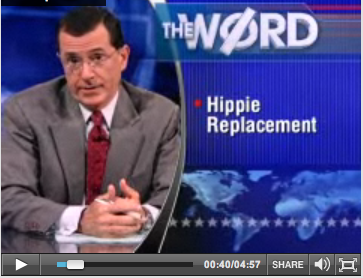
Picture 5Astroturf at Crapstock! Stephen Colbert proposes a successor to Woodstock – Crapstock, where like-minded memos and talking points come together from all over the country to oppose health care reform. “Since you can’t have an actual popular movement,” Colbert advises, “just say you have one. … We don’t need to look at what real people think to know what’s important. We can just look at our faxed memos …” He read from a memo advising opponents to pack town hall meetings, sitting in the front half of the hall, so they will look like a majority — even though a majority of Americans in fact support health care reform.

Among the “best practices” in a memo from Tea Party Patriots volunteer Bob MacGuffie:

– Artificially Inflate Your Numbers: “Spread out in the hall and try to be in the front half. The objective is to put the Rep on the defensive with your questions and follow-up. The Rep should be made to feel that a majority, and if not, a significant portion of at least the audience, opposes the socialist agenda of Washington.”

– Be Disruptive Early And Often: “You need to rock-the-boat early in the Rep’s presentation, Watch for an opportunity to yell out and challenge the Rep’s statements early.

– Try To “Rattle Him,” Not Have An Intelligent Debate: “The goal is to rattle him, get him off his prepared script and agenda. If he says something outrageous, stand up and shout out and sit right back down. Look for these opportunities before he even takes questions.”

NPR reports that the opposition is well-organized and national:

Many of the events this week appear to have been organized by conservative groups. A new Web site is called “Operation Embarrass Your Congressman.” A widely circulated memo tells right-wing protesters how to treat their representative: “Make him uneasy … stand up and shout out, and sit right back down … rattle him.”

And the Astroturf “organizing” goes beyond health care reform and packing town hall meetings, into probably prosecutable realms for one lobbying firm. TPM Muckraker reports on fake letters sent to oppose environmental legislation. The letters were sent by Bonner and Associates, a lobbying firm:

Bonner and Associates was working on behalf of the coal industry when it sent forged letters — purporting to come from local Hispanic and black groups — to a member of Congress, urging him to oppose the recent climate change bill. Bonner’s client was the American Coalition for Clean Coal Electricity, a top coal-industry advocacy group.

One of the letters went to Virginia first-term Congress member Tom Perriello, purporting to come from a Latino group in his district.

“They stole our name. They stole our logo. They created a position title and made up the name of someone to fill it. They forged a letter and sent it to our congressman without our authorization,” said Tim Freilich, who sits on the executive committee of Creciendo Juntos, a nonprofit network that tackles issues related to Charlottesville’s Hispanic community. “It’s this type of activity that undermines Americans’ faith in democracy.”

Family recession lessons From anger and stress to resilience and coping, the lessons that parents hope to teach and those that children are actually hearing may be miles apart, according to a fascinating and careful report by MPR. One family faces the “devastating” but seemingly inevitable loss of the home they built nine years ago.
Continue reading

1 Comment

Filed under Uncategorized

News Day: The Usual Suspects / Second chance / Credit unions in trouble / Twitter, iPhone dangers / Blue Dog deal

<a href="http://us.fotolia.com/id/5159529" title="" alt="">Soja Andrzej</a> - Fotolia.com

Soja Andrzej - Fotolia.com

The Usual Suspects The Pioneer Press has a new crime blog, dedicated to “chronicling bizarre and quirky tales from our crime and court beats.” I’m bookmarking and following it right now, so I don’t miss news that ranges from the absurd (a driver who blamed a crash on snakes in his pants, stupid criminals stories) to the straight news (Sheriff Fletcher defending himself for defending Gang Strike Force.) Okay – maybe sometimes the distinction between absurd and straight news isn’t so clear, but the blog promises to be a great read. Last night’s post – Wiliam Finney will not run against Bob Fletcher for sheriff in 2010.

Waterfall dries up Minnehaha Falls has fallen victim to the drought (precipitation is 16 inches below normal for the past 14 months), and now is only a trickle of its former self, reports the Pioneer Press. Minnehaha Falls dries up when the Minnehaha Creek Watershed District closes the Grays Bay Dam. That happened on June 2 this year, though the dam usually stays open until September. Other recent years when Minnehaha Falls was dried up: 2000, 1988 and 1964. The average precipitation by this time in the year is 17.36 inches, but the Twin Cities has received only 9.49 inches this year.

Second chance for MN refugees Three Salvadoran teens who fled their home country because of threats from the MS-13 gang may get a second chance at asylum in Minnesota, reports the TC Daily Planet:

They were recently jailed for about 17 days and faced imminent deportation. Then they scored a major victory. Not only were they released from jail, but the U.S. Department of Homeland Security also has joined with their attorneys to ask the Board of Immigration Appeals to reopen their case. Ben Casper, one of their attorneys, called DHS’s decision very unusual. “I have never heard of it before,” he said.

Conflict of interest for U of M doc? U of M Dr. David Polly received more than a million dollars from Medtronic, and U.S. Senator Charles Grassley (R-Iowa) thinks that may be a conflict of interest. Grassley is asking for an investigation, because “Polly went before Congress in 2006 and testified about a program that had ties to Medtronic, but Polly didn’t disclose his own ties to Medtronic,” reports MPR. U of M officials are reviewing the matter, and Polly remains on the Medtronic payroll.

Credit unions follow banks into deep water The Thumper Pond development is emblematic of new risks taken by some credit unions, reports the Star Tribune. When credit unions strayed from their traditional customers and loans to members, they courted the same trouble that banks have seen in the current economic crisis.

Losses on risky loans, from Twin Cities housing projects to out-of-state ethanol plants, are one reason why nearly half of the state’s 156 credit unions lost money in the most recent quarter, compared to 35 percent of credit unions nationwide. Seven of Minnesota’s credit unions are near or below capital levels the government deems adequate. And two were in such bad shape they had to be sold.

Want to check your credit union’s asset rating? The Strib has a list.

World/National news

Twitter danger BBC reports that a Chicago real estate company is suing a former tenant who tweeted about mold in her apartment. Horizon Group Management says her tweet was defamatory, and sued. Jeffrey Michael, whose family has run Horizon for decades, told the Chicago Sun-Times they didn’t talk to her about the tweet and didn’t ask her to take it down, saying, “We’re a sue first, ask questions later kind of an organisation.” Tenant Amanda Bonnen had 20 Twitter followers at the time that she posted the tweet, and has since closed her Twitter account.

iPhones in peril? Forbes.com reports on an iPhone hack that could “give a hacker complete power over any of the smart phone’s functions,” and then propagate itself to take over every iPhone in the world. Two cyber-security experts say that they notified Apple about the problem more than a month ago, but that it hasn’t released a patch.

If you receive a text message on your iPhone any time after Thursday afternoon containing only a single square character, Charlie Miller would suggest you turn the device off. Quickly.

The researchers have also found bugs in Windows Mobile and Google Android phones.

Beer today! BBC reports: “Cambridge police sergeant Jim Crowley and Henry Louis Gates, the Harvard scholar he arrested after responding to a report of a possible break-in at Mr Gates’s home, will sit down with Mr Obama on Thursday for a conciliatory beer.”

Is this the way to better race relations in America? If not, it is at least the way to a summer’s worth of late-night TV fodder. From across the pond, BBC thinks it is tempting to view the whole episode as the “ultimate conflation of the age of Obama and the age of Oprah,” adding that, “Aside from the choice of beverage, there is something very daytime television, something very soft focus, something very soft sofa, about this attempt to defuse the controversy.”

For a truly hysterical look at the entire flap, tune in to Colbert Nation on race and farts.

Refugees drown Some 200 people fleeing the poverty and starvation of Haiti crammed a homemade sailboat, enduring hunger and thirst for two days — and then the boat sank. NPR interviewed survivors, who said:

The boat was jam-packed with people. Men filled the deck, exposed to the hot sun, while women and men alike filled the dark, nearly airless hold below, survivors later told rescuers. Pierre said the hold was packed so tight that nobody could lie down.

118 people were rescued, after 17 hours in the water.

Pierre was among those returned to Haiti:

Pierre, who was reunited with his mother, said for all the horrors of the voyage he was still desperate to get out of Haiti, where 80 percent of the people survive on less than $2 a day.

Health care fact-of-the-day Courtesy of Paul Krugman: “Since 1970 Medicare costs per beneficiary have risen at an annual rate of 8.8% — but insurance premiums have risen at an annual rate of 9.9%. … if insurance premiums had risen “only” as much as Medicare spending, they’d be 1/3 lower than they are.”

Blue Dog deal Minnesota Budget Bites has an analysis of the deal struck by Blue Dog Democrats to allow the health care reform bill to move to the House floor. The deal allows a public option to remain, but limits tax increases and employer mandates. According to the New York Times:

The House changes, which drew immediate opposition from liberal lawmakers, would reduce the federal subsidies designed to help lower-income families afford insurance, exempt additional businesses from a requirement to offer insurance to their workers and change the terms of a government insurance option.

Leave a comment

Filed under news

News Day: Burnsville honkers / Broadband bust / MN science / War Reports

I spent a lot of time taking a longer look at health care, on the day before President Obama is expected to spend major press conference time on the issue. Take a look – and call your Senators and Congressmembers.

Burnsville cops don’t like peace protest Burnsville police have been watching a weekly anti-war vigil closely – and ticketing passing drivers who honk in support of the protesters, reports Jon Tevlin in the Strib. They have continued despite dismissal of the first anti-honking case and the existence of federal cases saying that honking is protected political speech. Police claim the protest causes traffic problems:
Continue reading

Leave a comment

Filed under news

Poynter Big Idea: Building community through journalism

Did you know that most of the black press contingent was barred from the Staples Center Michael Jackson memorial? Neither did I – but The Skanner did, and so did thousands of people who clicked on their story.

The Skanner news group is a 34-year-old African American newspaper in Portland and Seattle, an area that editor Lisa Loving described as overwhelmingly and demographically white, white, white,” adding that The Skanner is one of the few avenues in Seattle and Portland for the African American community to get their message out to a wider (and whiter) audience. Among The Skanner’s Big Ideas:

• A Google cold case map, created in cooperation with Portland police, which gets “mega hits” — and four of the cases have been solved.

• A mission to build web-based community service projects “rooted in our local communities but with an appeal to wider audience.” Two examples: an emergency preparedness page and a soon-to-launch project to help bridge the digital divide, that has led to a partnership with local Sabin CDC to run computer skills training at five community locations targeting job seekers, senior citizens, teen parents, and more. The Skanner also has a job search page with tips and links to help for resume-building, computer skills classes and more.

1 Comment

Filed under Uncategorized

Big Ideas at Poynter: The 7 to 7 breaking news blog

The 7 to 7 Breaking News Blog is the Providence Journal’s Big Idea – and all 80 reporters and photographers on the paper contribute, resulting in blog posts on every “interesting and important” story. Stories appear first as a single line or paragraph, following the motto, “Blog first – write now.” Updates add details, links, and more info.

Everything is edited before being published, but the lag time is still less than 10 minutes. Multiple reporters can contribute, with blog posts connected by common tags and similar heads.

One key: “Through frequent training of reporters and editors in the finer points of blogging — blog style, linking, tagging, etc. — we drive the point home repeatedly: We are serious about not just competing in, but winning, the breaking-news struggle with TV, radio and the Associated Press.”

Leave a comment

Filed under Uncategorized