News Day, written by Mary Turck, analyzes, summarizes, links to, and comments on reports from news media around the world, with particular attention to immigration, education, and journalism. Fragments, also written by Mary Turck, has fiction, poetry and some creative non-fiction.
Mary Turck edited TC Daily Planet, www.tcdailyplanet.net, from 2007-2014, and edited the award-winning Connection to the Americas and AMERICAS.ORG, in its pre-2008 version. She is also a recovering attorney and the author of many books for young people (and a few for adults), mostly focusing on historical and social issues.
People have lots of questions about recycling. Should you wash out beer bottles and jelly jars? Paper is good — but what about shredded paper? And what about light bulbs? Or window glass? What kind of plastic can you put in the blue box? And then there’s the big question: is recycling really worth it?
The Washington Post recently reported that recycling isn’t profitable any more. Whether recycling turns a profit is the wrong question. As a recent Mother Jones article points out, recycling succeeds financially if it just costs less than burying stuff in landfills. But financial success isn’t even half the story. Recycling succeeds by keeping trash out of landfills. Continue reading →
Welding vs. writing, machine shop vs. history — the battle for the souls of community colleges and state universities is on. The Star Tribune recently published a column by Fred Zimmerman, professor emeritus of engineering and management at the University of St. Thomas, who advocates an end to liberal education. Zimmerman urges legislators to:
“Work with the thoughtful MnSCU educators to improve relevance by shifting educational resources away from delusional and non-substantive, less-important general programs with questionable placement records toward the more sought-after technical programs such as welding, machinery and manufacturing, which are highly regarded by industry.”
Yep, that’s what I always thought college was about: welding and machinery and manufacturing. (Note that Zimmerman is not advocating that the University of St. Thomas or the University of Minnesota — both of which enroll students with substantially higher average incomes — abandon liberal education.) Continue reading →
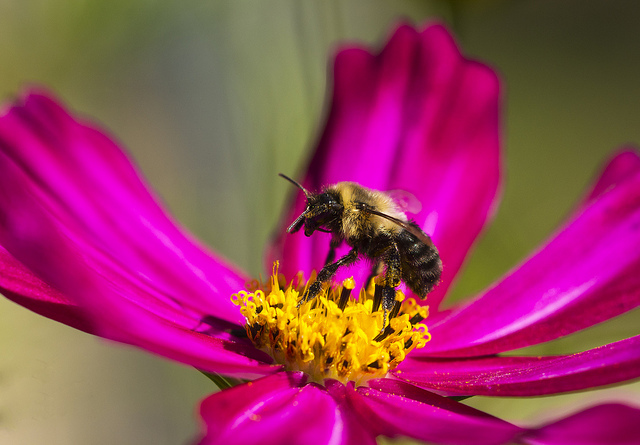
An Eden Prairie Boy Scout’s bee houses, pollinator gardens across the Twin Cities, and a bee highway in Norway highlight the urgency of preserving endangered native bees. Recent studies show that climate change, as well as pesticides and habitat loss, threatens native bees. This ongoing bee-pocalypse goes far beyond the colony collapse disorder of commercial honeybee hives that first hit the news a couple of years ago. Wild bees, hundreds of native species from big, furry bumblebees to solitary, ground-nesting andrenid bees, pollinate most of our plants, including food crops. Continue reading →
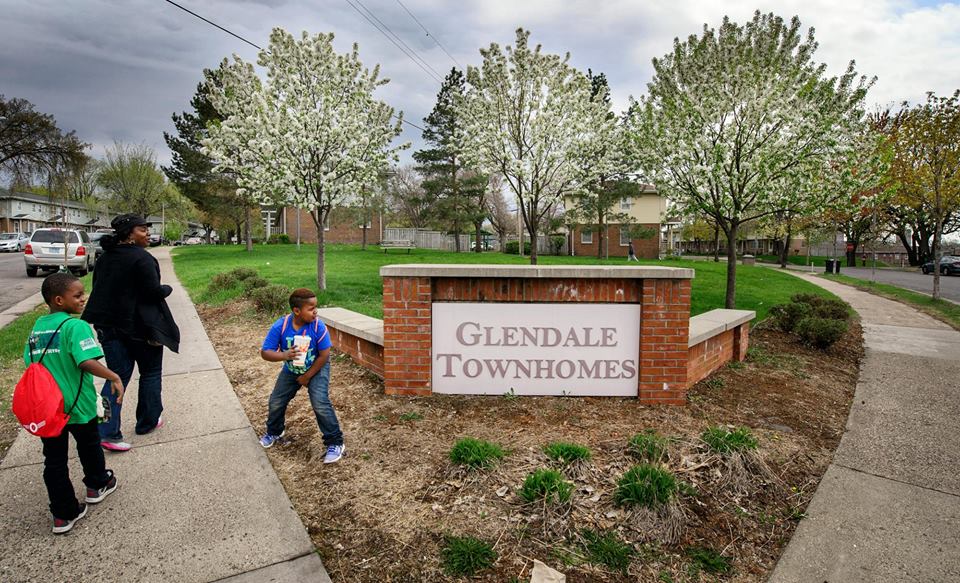
With average apartment rent in the Twin Cities at a record-breaking $1018 a month, Minneapolis Public Housing plans to send 184 families out looking for new places to live. That’s just one of the problems with the Minneapolis plan to knock down Glendale public housing and replace it with 550 new units that will mostly rent for market rates. Continue reading →
As smoke from drought-driven Canadian wildfires flows into Minnesota skies and lungs, Tom Lehrer’s “Pollution” reminds me of the work we’ve done and the work we have to do.
If you visit American city,
You will find it very pretty.
Just two things of which you must beware:
Don’t drink the water and don’t breathe the air!
Lehrer sang about pollution back in the 1960s, when rivers still burned and air-polluting, smog-generating particles poured out of every industrial smokestack and auto exhaust pipe. We cleaned up the rivers and air then. We can and must do it again. Continue reading →
Photo by photologue_np , published under Creative Commons license.
Almost one in five U.S. workers has a part-time job. Some people work part-time because it suits them, like a $100 an hour computer programmer. But more of them are like the part-timers featured in a 2014 New York Times article, and the 400+ people who wrote in to comment on it. Liz from Wheaton, Illinois, commented:
“As an RN with a master’s degree, you’d think I would fare better, but no. One Christmas Day not so long ago I was scheduled to work the 3-11 shift at the local hospital. I showed up for my shift but was told, “Didn’t someone call you? Our census is down and we don’t need you. But stay by your phone because you are on call for the next four hours” (without pay).”
Wild bees may be in even more peril than managed honeybee colonies, and they are essential to food production.
Because bees pollinate or fertilize crops, entomologist Thomas Seeley called them “flying penises” for plants. Bees are essential for our food supply and our ecological health. According to a May 13 USDA report, summer losses of honeybee colonies now exceed winter losses, for first time. Honeybees not the only, and maybe not the biggest problem: wild bees are in even greater peril than managed honeybee colonies. Continue reading →
With stone walls and grazing cattle, Irish farms look like tourist attractions, but farming is still serious business here.
Imagine being paid to maintain fragile land as permanent pasture. Imagine a farm subsidy program designed to support young farmers, small farms and organic farms. Imagine a farm program that declares that 30 percent of direct payments are conditioned on compliance with “greening” criteria, such as crop diversification and crop rotation. All that is part of Ireland’s agricultural economy, where agriculture and food produce 25 percent of the country’s export earnings. Continue reading →
I printed out flyers and business cards last week and went up and down the street, knocking on doors. The flyers tell people on my street, in my precinct, when and how and where they can vote. The business cards introduce me: Hi, Neighbor! I am Mary Turck. If you want to talk about voting […]
Dolores Huerta, United Farm Workers cofounder: “Every moment is an organizing opportunity, every person a potential activist, every minute a chance to change the world.” When I was ten years old, I wanted to go door-knocking for JFK. My parents vetoed the idea. When I was a few years older, I was allowed to go […]
Will your vote still count in 2026 or in 2028? Trump’s attacks on elections go beyond anything that has been attempted in the United States. He even told Reuters news service in an interview: “When you think of it, we shouldn’t even have an election.” This post has: a list of some of the attacks on voting and […]
This week’s firehose of news threatens to drown us all. I feel like I’m treading water, but even so, a few of the week’s stories stand out: more revelations of massive corruption in the Trump administration, dangerous escalations of electronic surveillance of all of us, a particularly nasty swatting attack on Pete Buttigieg’s family and […]
Seems like every week brings more news of government surveillance. You’d think the right wing would be up in arms about this government overreach and invasion of privacy—but it’s their folks who are taking the photos and setting up the databases of protesters and immigrants and anyone else who happens to get captured on some […]
Mary Turck is a writer, editor, and blogger. She is also the former editor of theTC Daily Planet and of the award-winning Connection to the Americas and AMERICAS.ORG and a recovering attorney.





 Mary Turck