
 Have you ever seen a bear cry? If the Hamm’s bear could see what’s happening to the sky blue waters he used to sing about, he’d be crying today. From green scum and fish kills in Albert Lea to mining pollution in northern Minnesota and the early closure of the walleye season on Mille Lacs, our water ain’t what it used to be. Continue reading
Author Archives: Mary Turck

Green scum on sky-blue waters
Filed under agriculture, environment
St. Paul school board candidates off and running
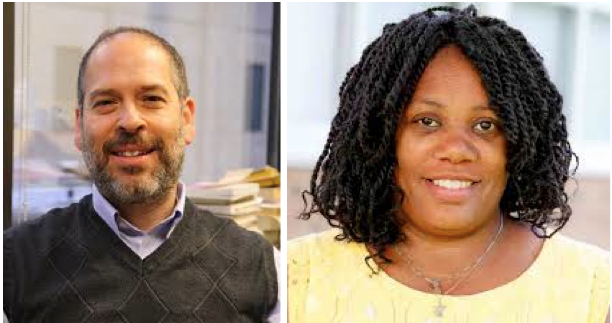
Steve Marchese and Zuki Ellis are two of the candidates in a field of nine. Others: Jon Schumacher, Mary Vanderwert, Keith Hardy, Scott Raskiewicz, Aaron Benner, Greg Copeland and Linda Freeman.
With filing now closed, St. Paul school board candidates include one who eschews social media and another inspired by “The Untouchables.” The five most serious candidates are DFL-endorsed Zuki Ellis, Jon Schumacher, Steve Marchese, and Mary Vanderwert, all of whom identify with the teachers-union-backed Caucus for Change, and school board incumbent Keith Hardy, who is running without endorsement. The four who are elected in November will deal continuing problems, including student achievement, discipline and budgets, as well as middle school students leaving the district.
Zuki Ellis has deep connections to St. Paul Public Schools, as an alum of Webster Elementary and Highland Park Senior High School, and the mother of three SPPS students. Her web page lists detailed and thoughtful positions on key issues from the botched mainstreaming initiative rolled out a couple of years ago to iPads in classrooms and corporate talk in the district office. On mainstreaming:
“For both Special Education and ELL students, the word ‘mainstreaming’ has been used to disguise blatant neglect for individual student progress, and I cannot support the way it has been carried out.
“By cutting entire programs for the sake of ‘mainstreaming’ students, without any regard for the needs of individual students, the district has shown a total disregard for those students’ potential to succeed. (They’re called Individual Education Plans for a reason.) “By providing additional support staff in the classroom, we can make steps toward making sure students are still getting the individual attention they need and deserve, and that our teachers are able to fully address the needs of all students.”
Filed under education, St. Paul Notes
My love/hate relationship with Metro Transit

Photo by m01229, used under Creative Commons license.
I love being able to take the bus or train, but sometimes the failures drive me crazy. My stop — at Temple Court on Cretin Avenue — exemplifies my love/hate relationship. After years of walking three-quarters of a mile to the nearest stop, I love that the bus now stops within a couple of blocks of my house. But — the stop fails anyone who needs accessible transportation. There’s no sidewalk: you have to walk on grass in the summer and snow or ice in the winter. Anyone using a wheelchair is out of luck, summer or winter. And there’s no bus shelter or bench for waiting. Continue reading
Filed under St. Paul Notes
Read a story, say a prayer, write a check: Remember Michael Brown
 Just for today, take one small step to remember Michael Brown’s death in Ferguson, one year ago today. Read one story (doesn’t have to be this one), say one prayer, send one check to an organization working for racial justice, talk to one family member or friend about race. Just for today, take one step, and then tomorrow, take another. One step after another, getting on the road.
Today, dozens of news reports say that Michael Brown’s family is still mourning his death, one year later. Well, yeah. Lots of families still mourn: Eric Garner. Tamir Rice. Samuel Dubose. Freddie Gray. Sandra Bland. Walter Scott. Eric Harris. The list goes on and on.
Last year, when Michael Brown was shot by a police officer, we didn’t know how many people were shot and killed by police in the U.S. every year. No government agency counted these deaths. A British newspaper stepped up. The Guardian’s The Counted project documents people killed by police in the United States. So far this year: 700. At the beginning of June, the Guardian reported:
“The Guardian’s statistics include deaths after the police use of a Taser, deaths caused by police vehicles and deaths following altercations in police custody, as well as those killed when officers open fire. They reveal that 29% of those killed by police, or 135 people, were black. Sixty-seven, or 14%, were Hispanic/Latino, and 234, or 50%, were white. In total, 102 people who died during encounters with law enforcement in 2015 were unarmed.
“The figures illustrate how disproportionately black Americans, who make up just 13% of the country’s total population according to census data, are killed by police. Of the 464 people counted by the Guardian, an overwhelming majority – 95% – were male, with just 5% female.”
Race matters. Race matters in life as well as in death. Ta-Nehisi Coates explained in “Letter to My Son” that: “Here is what I would like for you to know: In America, it is traditional to destroy the black body— it is heritage.” He asked readers to respond with their own stories of racism. They did, by the hundreds, their responses published in three separate Atlantic articles. One of the stories in the first article comes from a 35-year-old Florida reader, who begins:
“Crazy. Today is Sunday, July 5th. About two hours ago, I saw a tweet from Bomani Jones about Ta-Nehisi’s piece “Letter to My Son” and read it of course. It was a break from some work I was completing. I saw the request for personal stories about “The Talk.” (One of the commandments my mother gave me: When I get pulled over, pull over in a populated area so there will be witnesses.) I thought I would email a story later this week. I resumed my work but realized I needed a book I had left at the office. It’s about 20 minutes from my house, so I hopped in the car.”
He details the police following him, his stop at a gas station, what they say and do, and what he thinks, on a Sunday afternoon, near his home, before he is finally released to go get his book and resume his life:
“We walk up to my car so I can get my ID. I am fuming. I get my wallet and slam my door. ‘Calm down, I could be worse,’ says the other officer. I say, ‘I’m stopped here. Gun drawn on me. You’re right. I could be shot.’ He responds, ‘You don’t understand.’ I bite my tongue before I go off. I don’t understand? It’s a Sunday afternoon and here I am standing in a gas station parking lot, with my hands on my head, after having a gun pulled on me and patted down by an officer, all while another officer circled my vehicle with his hand on his weapon. He had a point; I guess the threat of being shot is better than being shot.”
Read the stories — Part I, Part II, and Part III. Today most white Americans say they are satisfied with the way that black Americans are treated. Not surprisingly, most black Americans disagree. One encouraging sign — the percentage of white Americans who are satisfied has dropped from 67 percent in 2013 to 53 percent in 2015. We can learn.
We must learn. And we must act. The problem with racism in this country goes far beyond policing. Racism shapes housing and segregation. Racism deforms education. Denial perpetuates its reign.
So step one: Read one story. Say a prayer. Send a check, Talk to someone. Take one step today. And another tomorrow.
Filed under human rights, race
Immigrant slave labor and anti-immigrant actions from Texas to Washington
 Here’s July’s round-up of immigration news, including:
- Immigrant slave labor in U.S.?
- Anti-immigrant action and rhetoric: Texas to Washington
- Federal judge: Let the children go
- Europe and immigrants
- Haiti: Refugees from Dominican Republic arrive
- And in Minnesota — immigrant vitality and economic contributions
Filed under immigration
Why I haven’t been blogging much lately
My father, Howard Turck, died on July 30, after a long and gallant struggle with Alzheimer’s disease. He was a blessing to his family and his community, and we mourn his passing from us. With other family members, I spent much time with him in his final weeks, and we said goodbye to him today. I have posted the eulogy I gave at his funeral on my Fragments blog.
I’ll return to News Day tomorrow.
Filed under Uncategorized
MPR makes us all losers
MPR laid off nine news people yesterday. That’s nine full and part-time people from a full and part-time staff of 74, according to the Pioneer Press. For the news people leaving and the news people staying and for all of us who count on MPR for news, that’s a major blow.
Nick Woltman’s story in the Pioneer Press also aggregated tweets from MPR’s Bob Collins, which paid tribute to each of the nine employees. I couldn’t find any other new stories about the layoffs, which make Minnesota’s news landscape poorer and more barren. As Collins observed, “it is against the law of physics to remove creativity from a world and expect creativity to flourish in its place.” (By the way, if you don’t already follow Bob Collins on Twitter and on his News Cut blog, you should. Right now.)
All of the nine will be missed. I will especially miss Alex Friedrich, who reported carefully and caringly about Minnesota higher education, and Cat Richert, whose coverage of politics and fact-checking in Poligraph provide essential insights into how government works.
Friedrich and Richert represent a kind of reporting too often under-appreciated: covering a beat, getting to know the players and institutions, building a deep background and insight into the issues, which takes time on the job and can’t be easily replaced. Any shenanigans in higher ed or in the legislature will be harder to follow and harder to expose without their deep knowledge and careful reporting.
American Public Media, MPR’s parent company, signaled earlier this month that layoffs were coming. An internal memo said that changes would “expand our services in health, education and sustainability – adding to our current strengths in business and public affairs journalism, and classical and contemporary music.” Cutting to the bone does not accomplish that end.
Bob Collins got it right yesterday in his series of tweets about the layoffs.
Some layoffs apparently took place earlier in the month — I don’t know who those people were. You can go to the MPR pages of the people laid off yesterday, and read or view or listen to the work they have produced in the past. I hope they all land in places where they can continue to do good journalism work in the future. They will be missed.
- Nikki Tundel (reporter)
- Jeffrey Thompson (photographer)
- Jennifer Simonson (photographer)
- Chris Roberts (arts & culture reporter)
- Emily Kaiser (associate digital producer)
- Alex Friedrich (reporter, focus on higher education)
- Cat Richert (news, legislature, politics)
- David Cazares (news editor, jazz and Latin music)
- Beth Kidd (newscaster – no page available)
Spill, spill, and spill again: Oil across the continent

Photo by Steven Storm from protest in Santa Barbara after May oil spill, published under Creative Commons license
A new, state-of-the-art double-layer pipeline failed last week in Alberta, causing a massive leak of 1.3 million gallons of oil, water and sand. But that’s not all: July has been a banner month for oil spills, and it’s not over yet. The entire year has seen spill after spill, from pipelines and oil train derailments. Here’s a brief recap of just those spills that made it into my files — and the Wisconsin legislature’s capitulation to Enbridge. Continue reading
Filed under environment
The relativity of poverty

Photo by Stephen Kruso, published under Creative Commons license
You’re a new mom. Maybe a single mom, but even if your husband is there, you have trouble making ends meet. Who knew kids were so expensive? And who knew diapers would be the final, unbearable expense? Jessica Aragon told NBC that she “was once so desperate for diapers she considered stealing them.” That was 13 years ago, but Aragon still remembers feeling ashamed when she would have to leave her baby in a wet diaper because she didn’t have enough diapers. Continue reading
Filed under children
Minnesota CEOs get raises and workers don’t

Photo by Peter Kaminski, published under Creative Commons license.
The top dogs at publicly-traded Minnesota companies earned an average of $1.21 million a year in 2014, up 18 percent from 2013. The chief executive officer pay at these 95 companies was the second highest since 2007. Did you get an 18 percent raise last year?
Filed under work
 Mary Turck